Yeah, I'm p.o.-ed right now. Looks like the Not-Respected Slimy Asshole Senator from Tennessee had the pieces already lined up to drop into place, because the following appeared on his site, all but instantaneously, in the wake of his successfully attaching his pet anti-gambling legislation to the port-security bill pushed through the Senate earlier this evening:
FRIST STATEMENT ON PASSAGE OF INTERNET GAMBLING LEGISLATION
September 29th, 2006 - WASHINGTON, D.C. – U.S. Senate Majority Leader Bill Frist, M.D., (R-Tenn.) made the following statement after the Senate passed the Unlawful Internet Gambling Enforcement Act:
“Gambling is a serious addiction that undermines the family, dashes dreams, and frays the fabric of society. Congress has grappled with this issue for 10 years, and during that time we’ve watched this shadow industry explode. For me as majority leader, the bottom line is simple: Internet gambling is illegal. Although we can’t monitor every online gambler or regulate offshore gambling, we can police the financial institutions that disregard our laws.”
For those with a high tolerance to nausea, you can verify the above for yourself here.
I could go on a long rant about centrist America allowing the two major U.S. parties allowing themselves to be usurped by extremist views. (This applies particularly to the Republican far right, but is applicable to both outer wings.)
I could rant, but I'll just say this, oh normal-thinking Americans, especially those of moderately conservative views: As ye have sown, so shall ye reap.

Saturday, September 30, 2006


Friday, September 29, 2006
The Titan Poker Promotional Shuffle
Here's something I admire: a poker site that's willing to try things in an effort to discover a new magic formula for commercial success. I'm going to have to give it up for Titan Poker (http://www.titanpoker.com/) in tonight's post, not that I spend a whole lot of time on the site. Nonetheless, they're giving it the old college shot, coming up with several new promotional ideas that, while they might not work out, are at least interesting concepts.
 The most interesting is Titan's new "Million Dollar Sit 'N' Go." It's one of those everyman's-dream ideas, wherein the first 20 players that make three consecutiive final tables (out of a list of mostly $10 and $20-entry events), win one of 20 seats into this million-dollar giveaway. I like it, as a marketing concept. It's the dangling of big cash for a very modest investment, and it comes with something that a lot of promotional ideas overlook... the inexpensive escape clause. If you play a few and don't make a run or get hooked on the concept, then, hey --- stop playing!
Titan's also the first of the iPoker skins to announce an improvement in what we can presume to be the basic iPoker tournament structure --- they (iPoker) have now increased the starting chip stacks in their tourneys from 1,000 to 1,500 chips. In light of the million-dollar promotion, this iPoker change couldn't come at a better time. The worst surface drawback to giving the million-dollar baby a whirl was iPoker's sucky structure --- with shallow starting chip stacks and rapidly increasing blinds (among the worst in the biz), these things have always been crapshoots.
And that's another reason Titan deserves a positive mention. After all, being tied to iPoker has always mean that they've had to try to make a silk purse out of the proverbial sow's ear of all poker-software backbones. The iPoker software has always been clunky, counter-intuitive to the user, and let's not forget an issue we reported on a few months back wherein it was discovered that the system passwords for the users were being stored as plain text, rather than in an encrypted fashion. iPoker responded to the hullabaloo by declaring that it was only the play-money password that was uncrypted, but that was clearly b.s. --- no site requires separate passwords for play-vs.-real money use. In any event, iPoker did go ahead and rectify the situation, showing that, yeah, they do read the press clippings. So your passwords are safe, now.
But it hasn't been all roses for Titan either. There was a situation a few months back where a person qualified as a winner of the iPoker "Rio Sit-'N'-Go Jackpot" promotion, and was denied a sizeable payday on very questionable "collusion" grounds. That one was a judgment call, but I'm not aware that iPoker ot the sponsoring skin (I believe it was Titan), ever made a clarifying statement on the matter. And as I said, I believe it was a Titan player, though it might also have been a Noble or CD Poker player; I disremember the details and am disinclined to look. In the larger sense, it didn't matter --- it threw a cloud over the whole "Jackpot" program.
Another example was that laughable $500,000,000 million freeroll or whatever it was --- where all that money was yours, if you hit a royal flush at the final table. Not only were the odds extreme, but for me that promotion ran into that ephemeral wall where we trust the honesty of the online game. While it's easy enough for someone like iPoker (with contributions from the skins), to purchase a Lloyd's of London-style insurance policy based on the risk, it's also easy to imagine a server failure if the table cards happened to produce that improbable royal flush. I don't believe that such a thing would have happened, but the ridiculously high stakes would have at least created the incentive. Reality? No. But dark fears are a very real part of the online game, even for those who have been around for a while and know what's what. The fear of the unknown, the sense of the detachment --- these are all parts of the human psyche.
Those facets of human nature made for a bad fit with that marketing concept; it was one of those 6-sigma things where the outliers were just too high. I looked at the promotion, decided I didn't need to chase dreams quite that wild, and wandered elsewhere. I'm guessing other players did the same: after the initial appearwnce of the press releases on those sites that just grab any poker-newsy info, it faded rapidly from sight.
And that's where the current concept succeeds. It's much more believable, is far easier to quantify as you try your luck, and might just attract a few new or returning players, despite the weight of the iPoker yoke.
At the least, it got my interest.
 The most interesting is Titan's new "Million Dollar Sit 'N' Go." It's one of those everyman's-dream ideas, wherein the first 20 players that make three consecutiive final tables (out of a list of mostly $10 and $20-entry events), win one of 20 seats into this million-dollar giveaway. I like it, as a marketing concept. It's the dangling of big cash for a very modest investment, and it comes with something that a lot of promotional ideas overlook... the inexpensive escape clause. If you play a few and don't make a run or get hooked on the concept, then, hey --- stop playing!
 Titan's also the first of the iPoker skins to announce an improvement in what we can presume to be the basic iPoker tournament structure --- they (iPoker) have now increased the starting chip stacks in their tourneys from 1,000 to 1,500 chips. In light of the million-dollar promotion, this iPoker change couldn't come at a better time. The worst surface drawback to giving the million-dollar baby a whirl was iPoker's sucky structure --- with shallow starting chip stacks and rapidly increasing blinds (among the worst in the biz), these things have always been crapshoots.
And that's another reason Titan deserves a positive mention. After all, being tied to iPoker has always mean that they've had to try to make a silk purse out of the proverbial sow's ear of all poker-software backbones. The iPoker software has always been clunky, counter-intuitive to the user, and let's not forget an issue we reported on a few months back wherein it was discovered that the system passwords for the users were being stored as plain text, rather than in an encrypted fashion. iPoker responded to the hullabaloo by declaring that it was only the play-money password that was uncrypted, but that was clearly b.s. --- no site requires separate passwords for play-vs.-real money use. In any event, iPoker did go ahead and rectify the situation, showing that, yeah, they do read the press clippings. So your passwords are safe, now.
But it hasn't been all roses for Titan either. There was a situation a few months back where a person qualified as a winner of the iPoker "Rio Sit-'N'-Go Jackpot" promotion, and was denied a sizeable payday on very questionable "collusion" grounds. That one was a judgment call, but I'm not aware that iPoker ot the sponsoring skin (I believe it was Titan), ever made a clarifying statement on the matter. And as I said, I believe it was a Titan player, though it might also have been a Noble or CD Poker player; I disremember the details and am disinclined to look. In the larger sense, it didn't matter --- it threw a cloud over the whole "Jackpot" program.
Another example was that laughable $500,000,000 million freeroll or whatever it was --- where all that money was yours, if you hit a royal flush at the final table. Not only were the odds extreme, but for me that promotion ran into that ephemeral wall where we trust the honesty of the online game. While it's easy enough for someone like iPoker (with contributions from the skins), to purchase a Lloyd's of London-style insurance policy based on the risk, it's also easy to imagine a server failure if the table cards happened to produce that improbable royal flush. I don't believe that such a thing would have happened, but the ridiculously high stakes would have at least created the incentive. Reality? No. But dark fears are a very real part of the online game, even for those who have been around for a while and know what's what. The fear of the unknown, the sense of the detachment --- these are all parts of the human psyche.
Those facets of human nature made for a bad fit with that marketing concept; it was one of those 6-sigma things where the outliers were just too high. I looked at the promotion, decided I didn't need to chase dreams quite that wild, and wandered elsewhere. I'm guessing other players did the same: after the initial appearwnce of the press releases on those sites that just grab any poker-newsy info, it faded rapidly from sight.
And that's where the current concept succeeds. It's much more believable, is far easier to quantify as you try your luck, and might just attract a few new or returning players, despite the weight of the iPoker yoke.
At the least, it got my interest.
Thursday, September 28, 2006
SUBJ: Closure of Your William Hill Account
And another one bites the dust.
This time it's William Hill Poker, one of the largest skins on the Cryptologic Network, which has decided to bid a tearful adieu to U.S. customers. As excerpted from an e-mail:
 "William Hill plc has taken a decision to withdraw our online casino and poker services from all existing US clients and will refrain from offering them to US residents in the foreseeable future.
"We regret to inform you that we have therefore suspended your account and you will not be able to access our casino or poker room in the future. You should also note that we do not take sports bets from US residents."
In other words, they feel the heat. The ridiculous extradition agreement that the United Kingdom has with the U.S. is causing severe hesitancy among UK-listed online poker sites to continue to do business with the U.S.
I expect others to follow, which will fall into two categories: those sites which are incorporated in the UK, and are therefore subject to our country's overzealous reach, and those who just don't do much business with U.S. customers to begin with. The poker sites who'll be left to continue the fight will also fall into two categories: those who are are already big and have sizeable U.S. based customer bases, this being Stars, Party and the like, and those companies housed in non-UK nations who rightfully need to tell the U.S. (at least on this matter) to K.M.A. on an international scale.
A greater schism awaits. When logic doesn't work, try manipulation. If manipulation doesn't work, go for brute fear. Now whose government's illicit strategies could this possibly refer to?
This time it's William Hill Poker, one of the largest skins on the Cryptologic Network, which has decided to bid a tearful adieu to U.S. customers. As excerpted from an e-mail:
 "William Hill plc has taken a decision to withdraw our online casino and poker services from all existing US clients and will refrain from offering them to US residents in the foreseeable future.
"We regret to inform you that we have therefore suspended your account and you will not be able to access our casino or poker room in the future. You should also note that we do not take sports bets from US residents."
In other words, they feel the heat. The ridiculous extradition agreement that the United Kingdom has with the U.S. is causing severe hesitancy among UK-listed online poker sites to continue to do business with the U.S.
I expect others to follow, which will fall into two categories: those sites which are incorporated in the UK, and are therefore subject to our country's overzealous reach, and those who just don't do much business with U.S. customers to begin with. The poker sites who'll be left to continue the fight will also fall into two categories: those who are are already big and have sizeable U.S. based customer bases, this being Stars, Party and the like, and those companies housed in non-UK nations who rightfully need to tell the U.S. (at least on this matter) to K.M.A. on an international scale.
A greater schism awaits. When logic doesn't work, try manipulation. If manipulation doesn't work, go for brute fear. Now whose government's illicit strategies could this possibly refer to?
Sunday, September 24, 2006
Jamie Gold and the Table-Talk Limits
Those of you getting your 2006 WSOP Main Event fixes over the tube (via ESPN) are now getting a chance to see some of the table behavior that had a few people not too crazy about Jamie Gold, at least those that were there to see it first-hand. This was long before the now-famous lawsuit filed by Crispin Leyser, over the half of Gold's winnings alledgedly promised to Leyser as compensation for assistance in fulfilling the deal that allowed Gold to compete in the WSOP in the first place.
I predicted several weeks back --- actually, before the Leyser lawsuit was filed --- that Gold was well on his way to becoming the most reviled Main Event winner ever. While there's stiff competition (considering, as one example, Amarillo "Slim" Preston's conviction for molesting his granddaughter), the fact is that Gold's done a great job of putting himself out there as a poster boy for unethical behavior at the table, and in the poker world.
Really, while the WSOP tourney directors have come in for a lot of hell recently for other reasons (see posts here --- and everywhere else --- about the two-million-extra-chips controversy), I can't think of a valid reason why that coded table talk gets a pass during the last few tables of a big tournament. Gold's edited "top-top" comments to Lee Kort were just one example of what went on throughout. Early on in the tourney, where there are literally hundreds of tables going on at the same time, then complaints about inappropriate talk usualy degenerate into a "He said" pile of nothing, and no action is taken. Late in a big event, though, with all the cameras running and handfuls of tourney directors hovering over the players' shoulders --- and you don't see them, but they are there --- there's no excuse for not awarding the consistent violators, a la Jamie Gold, with a few trips to the rail as inducement to clean up their acts.
Says me.
I predicted several weeks back --- actually, before the Leyser lawsuit was filed --- that Gold was well on his way to becoming the most reviled Main Event winner ever. While there's stiff competition (considering, as one example, Amarillo "Slim" Preston's conviction for molesting his granddaughter), the fact is that Gold's done a great job of putting himself out there as a poster boy for unethical behavior at the table, and in the poker world.
Really, while the WSOP tourney directors have come in for a lot of hell recently for other reasons (see posts here --- and everywhere else --- about the two-million-extra-chips controversy), I can't think of a valid reason why that coded table talk gets a pass during the last few tables of a big tournament. Gold's edited "top-top" comments to Lee Kort were just one example of what went on throughout. Early on in the tourney, where there are literally hundreds of tables going on at the same time, then complaints about inappropriate talk usualy degenerate into a "He said" pile of nothing, and no action is taken. Late in a big event, though, with all the cameras running and handfuls of tourney directors hovering over the players' shoulders --- and you don't see them, but they are there --- there's no excuse for not awarding the consistent violators, a la Jamie Gold, with a few trips to the rail as inducement to clean up their acts.
Says me.
WWE and ECW Announce "Extreme Strip Poker"
Every time this blog runs something a bit unusual, the hits go way-y-y up. With that in mind, we're happy to note that that bastion of sports-tertainment, World Wrestling Entertainment (WWE), has announced that a dilettante's worth of wrestling divas will participate in "Extreme Strip Poker," which will run as part of the Extreme Championship Wrestling (ECW) brand. The episode will first air on October 10th, on the Sci-Fi Network --- and I had no idea that Sci-Fi Network was doing all-star wrestling these days, which ranks right up with BET running rap videos all day and calling itself an "educational" channel --- and the show will highlight divas from several of the major WWE shows. Divas from RAW and Smackdowns will join the ECW Vixens in this one.
 There's just not a whole lot more that needs to be said. ECW wryly asks, "Which Diva or Vixen will bring her poker face to ECW in less than three weeks?"
Uhh, I don't think the guys watching will be paying too much attention to the poker faces. Call it a hunch.
(Photo source: Extreme Championship Wrestling)
 There's just not a whole lot more that needs to be said. ECW wryly asks, "Which Diva or Vixen will bring her poker face to ECW in less than three weeks?"
Uhh, I don't think the guys watching will be paying too much attention to the poker faces. Call it a hunch.
(Photo source: Extreme Championship Wrestling)
The "Next Poker" --- It's... Poker!?!?!?
Few things in the marketing world are worth as deep a belly-laugh as the highly crafted press release that has absolutely nothing to say. Sure enough, the rumblings began soon after I stumbled across a press release that started with the following:
 "Pot Limit Omaha, which offers more action than No Limit Holdem, appears poised to become the poker experts’ next Cadillac of Poker, according to Las Vegas pros. Pot Limit Omaha offers players 6 times as many starting combinations as Holdem poker games and keeps the betting action alive more readily than No Limit Holdem. TruePoker offers free tournaments in Pot Limit Omaha every day, with real cash prizes."
Oh, okay, True Poker. (Lame name, too. Always has been.) Now, I understand the need for creating buzz, but I don't think the "next big thing" thing will work here, particularly when all the site offers is Hold'em and Omaha. Seems to me that the next big thing within poker's boundaries is the offering of more and better poker variants, not just finding an angle to pitch the same ol' basic crap down our throats. For crying out loud, a site called Superior Poker is serving up both Chinese Poker and Pan these days. And we're supposed to get excited about Omaha and Omaha-8?
Well, the release does borrow freely from other sources, and even includes an erstwhile "Mikey the Chimp" reference, quite literally out of left field. It's even better than you think:
"(Even Mikey the Chimp, turned away from play at the WSOP, has taken up No Limit Holdem.)"
Really? I thought this release was about Omaha, wasn't it?
The siren song of crap --- I just cannot resist it. Predictably, the release provides a non-working link back to the main True Poker site. (Watch 'em fix it, now, or pull the release in its entirety.) Open note to True Poker: When you're working on standard web content, like... say... a blog, then the occasional techie typo will occur. But in the form of a press release, to not even have one's own home-page link right is guffaw-inducing. Try testing it next time --- you certainly didn't have any newsworthy content to be preoccupied with, to distract you from the basics.
One thing I noticed after fixing the obvious link error and checking out the site --- True Poker does have its own unique avatars and software set-up. One software feature is indeed a throwback to the early days of online poker, when you actually clicked a button to view your own hole cards. It led to a blatant online tell that (I believe it was) John Vorhaus pointed out in one of his "Playing Killer Online Poker" books --- similar to brick-and-mortar novices, anyone checking their hole cards after a card that completes a possible draw is likely to have made that straight or flush. Still, I thought that tell went out with Pokemon cards, but now it's back.
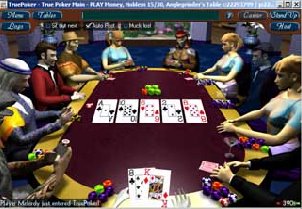
Lame poker sites, they never die. They just keep on flopping.
And an update! This post received one of those Anonymous-signed comments that read something like this: "True Poker has been around a helluva lot longer than you."
Well-l-l, I knew perfectly well that True Poker's been around since 2001 or so, and that it very likely was the inspiration for the tell as explained in the Vorhaus book. (That or a similar site based on the same software.) But as for it being around longer than me, umm, no --- despite the fact that I've only taken up writing about the game in the last couple of years. Whether or not I've been out here communicating about the game has nothing to do with how long I've been playing or gathering knowledge, and I've been onto online poker since way back. I was a player on Paradise before Party ever came to be, and I've played live poker for something like 35 years now. Besides, I do not buy the argument that age alone is the deciding factor in deciding who has the right to offer an opinion. Never have, never will. A newbie can see something that an old-timer can miss, though it happens less often. Where do you think the saying about "a fresh pair of eyes" came from?
You know, I didn't even bother picking apart the blind reference in the quote referenced above, about the Vegas pros calling PLO the next Cadillac of Poker. I call bullshit. Name some. Or go back under your rock.
Just so ya's all know --- I'll let the comments stand from just about anyone, as long as whoever does the writing has the balls to sign his name. (Or if the comment has a constructive point to make.) I have no problem with dissecting garbage-y fluff pieces that have no reason to exist, like the True Poker release, because exposing pap as pap is a public service. That I choose to have some fun with it is just who I am, part of my own hard edge, but I stand behind everything I write.
So, to Mr. Anonymous --- who I really suspect was one of True Poker's marketing managers or an affiliate or something, tracking the success of failure of the release --- grow some. Or pass the word up the True Poker chain: Try using your revenue stream to add new things to your site, rather than using it to re-market the same old shit.
Got it? I knew you would.
 "Pot Limit Omaha, which offers more action than No Limit Holdem, appears poised to become the poker experts’ next Cadillac of Poker, according to Las Vegas pros. Pot Limit Omaha offers players 6 times as many starting combinations as Holdem poker games and keeps the betting action alive more readily than No Limit Holdem. TruePoker offers free tournaments in Pot Limit Omaha every day, with real cash prizes."
Oh, okay, True Poker. (Lame name, too. Always has been.) Now, I understand the need for creating buzz, but I don't think the "next big thing" thing will work here, particularly when all the site offers is Hold'em and Omaha. Seems to me that the next big thing within poker's boundaries is the offering of more and better poker variants, not just finding an angle to pitch the same ol' basic crap down our throats. For crying out loud, a site called Superior Poker is serving up both Chinese Poker and Pan these days. And we're supposed to get excited about Omaha and Omaha-8?
Well, the release does borrow freely from other sources, and even includes an erstwhile "Mikey the Chimp" reference, quite literally out of left field. It's even better than you think:
"(Even Mikey the Chimp, turned away from play at the WSOP, has taken up No Limit Holdem.)"
Really? I thought this release was about Omaha, wasn't it?
The siren song of crap --- I just cannot resist it. Predictably, the release provides a non-working link back to the main True Poker site. (Watch 'em fix it, now, or pull the release in its entirety.) Open note to True Poker: When you're working on standard web content, like... say... a blog, then the occasional techie typo will occur. But in the form of a press release, to not even have one's own home-page link right is guffaw-inducing. Try testing it next time --- you certainly didn't have any newsworthy content to be preoccupied with, to distract you from the basics.
One thing I noticed after fixing the obvious link error and checking out the site --- True Poker does have its own unique avatars and software set-up. One software feature is indeed a throwback to the early days of online poker, when you actually clicked a button to view your own hole cards. It led to a blatant online tell that (I believe it was) John Vorhaus pointed out in one of his "Playing Killer Online Poker" books --- similar to brick-and-mortar novices, anyone checking their hole cards after a card that completes a possible draw is likely to have made that straight or flush. Still, I thought that tell went out with Pokemon cards, but now it's back.
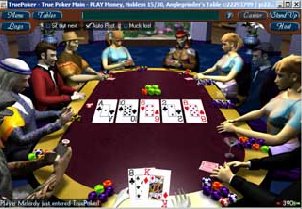
Lame poker sites, they never die. They just keep on flopping.
And an update! This post received one of those Anonymous-signed comments that read something like this: "True Poker has been around a helluva lot longer than you."
Well-l-l, I knew perfectly well that True Poker's been around since 2001 or so, and that it very likely was the inspiration for the tell as explained in the Vorhaus book. (That or a similar site based on the same software.) But as for it being around longer than me, umm, no --- despite the fact that I've only taken up writing about the game in the last couple of years. Whether or not I've been out here communicating about the game has nothing to do with how long I've been playing or gathering knowledge, and I've been onto online poker since way back. I was a player on Paradise before Party ever came to be, and I've played live poker for something like 35 years now. Besides, I do not buy the argument that age alone is the deciding factor in deciding who has the right to offer an opinion. Never have, never will. A newbie can see something that an old-timer can miss, though it happens less often. Where do you think the saying about "a fresh pair of eyes" came from?
You know, I didn't even bother picking apart the blind reference in the quote referenced above, about the Vegas pros calling PLO the next Cadillac of Poker. I call bullshit. Name some. Or go back under your rock.
Just so ya's all know --- I'll let the comments stand from just about anyone, as long as whoever does the writing has the balls to sign his name. (Or if the comment has a constructive point to make.) I have no problem with dissecting garbage-y fluff pieces that have no reason to exist, like the True Poker release, because exposing pap as pap is a public service. That I choose to have some fun with it is just who I am, part of my own hard edge, but I stand behind everything I write.
So, to Mr. Anonymous --- who I really suspect was one of True Poker's marketing managers or an affiliate or something, tracking the success of failure of the release --- grow some. Or pass the word up the True Poker chain: Try using your revenue stream to add new things to your site, rather than using it to re-market the same old shit.
Got it? I knew you would.
Vanessa Rousso Spills the Relationship Beans
Sorry, guys. It seems like Vanessa Rousso is taken, at leat for the time being.
While it's likely one of those "open" secrets within poker's higher echelons, Vanessa Rousso let it slip while doing color commentary on a recent Bluff/WCOOP podcast that her current romantic interest is none other than... Chad Brown. I guess a "Sorry, girls," is also in order.
 Both Rousso and Brown have been in the news in recent days, but for major poker success, not for this. Rousso just wrapped up her first major title, taking down Event #9 at the Borgata Poker Open, a $5,000-buyin, no-limit event. That win was worth a paltry $285,450 for the erstwhile Duke University law student.
As for Brown, all he's done in recent days is lead the way to the European Poker Tour event in London, although late reports indicate that he was knocked out in fifth, while another woman, Vicky Coren, won the event. (And, by the way, go-o-o-o girls!)
So, will hot psuedo-celebrity romantic relationships be the next big thing among the hot young pokerscenti? Does anyone really care? Heh. Probably not. But news is news, so, well, now you know. And we now return to our regularly scheduled poker features.
While it's likely one of those "open" secrets within poker's higher echelons, Vanessa Rousso let it slip while doing color commentary on a recent Bluff/WCOOP podcast that her current romantic interest is none other than... Chad Brown. I guess a "Sorry, girls," is also in order.
 Both Rousso and Brown have been in the news in recent days, but for major poker success, not for this. Rousso just wrapped up her first major title, taking down Event #9 at the Borgata Poker Open, a $5,000-buyin, no-limit event. That win was worth a paltry $285,450 for the erstwhile Duke University law student.
 As for Brown, all he's done in recent days is lead the way to the European Poker Tour event in London, although late reports indicate that he was knocked out in fifth, while another woman, Vicky Coren, won the event. (And, by the way, go-o-o-o girls!)
So, will hot psuedo-celebrity romantic relationships be the next big thing among the hot young pokerscenti? Does anyone really care? Heh. Probably not. But news is news, so, well, now you know. And we now return to our regularly scheduled poker features.
Saturday, September 23, 2006
The Photo Dump Returneth: WSOP and Poker Dome Highlights
Let's take a break from them edgier stuff again today, and return to some of the sights from the World Series of Poker and the Mansion Poker Dome, two events of more than casual interest around these parts.
While I've yet to see a final summary posted on the web, it's safe to say that a significant percentage of all the WSOP Main Event entrants won their seats online, certainly several thousands of the 8,773 ME participants. Players who qualified through the largest sites, such as Poker Stars, Bodog, or Full Tilt, also had special access to the hospitality suites that ringed the Amazon Room and the action itself.
Most of the suites were split into two parts, a public-access area toward the front and a more-exclusive, players/staff section at the back. In most cases the semi-private players' lounges were designed to allow the biggest of the sites' endorsers a convenient spot to relax, talk, eat, play some cards --- in general, to just get off the floor for a bit. Of those suites that were closest to the action, Full Tilt's had the most style, as can be seen here:

A nice setup, tastefully classy, as compared to Bodog's back area, which was more like one of those dimly-lit, crimsom-appointed '70s-era singles lounges that, thank the forces that be, no longer populate the landscape in quite as huge numbers. (Which doesn't mean I wasn't expecting to see Calvin Ayre look-alikes in white disco jumpsuits, complete with hairy chests and cheesy bling. Thankfully, that was just a hallucination.)
Barely visible in the Full Tilt Poker photo above is the back-wall mural, which built upon that 'Fremont St. Gang' ad concept that Full Tilt has used for some time. Here's what that looked like, though this photo does not capture the scope of the work:

Of course, you might have the impression that these lounges were deserted, but although they closed in the early evening, that wasn't the case. Each had the usual looker traffic, day after day, and the players, especially after being knocked out of other events, often played their own cash games in the back. Andy Bloch took a break from a cash game in the Full Tilt area to pose for this cheap-camera shot:

One of the reasons I like this photo, poor quality aside, is that despite the cavernous nature of the Rio Convention Center, space can still a be a premium on the small scale. All those boxes full of promotional goodies and hospitality-suite decorations have to go somewhere, don't they? And though they might be obscured from the general public's view, rest assured that for everyone --- not just Full Tilt --- the clutter was just out of sight.
Moving on.
If you want to see the famous faces of the poker world, well, there's no place like (the) Rio in July. You've probably noticed a sprinkling of photos in past posts, but I didn't take that many poker-star shots; other tasks had greater priority. Still, here's a few for your entertainment...
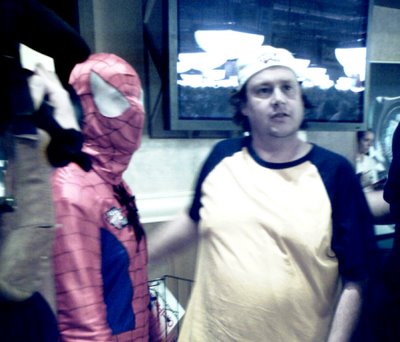
Here's Gavin Smith and Joe "Spidey" Sebok on the last of the four Day Ones of the Main Event, part of the payoff in a rather famed bet between the two. Too bad I missed the "bear in a diaper" day, but then again, it could have been worse --- imagine Joe in a "Wonder Woman" costume or something. Ick. Anyhow:
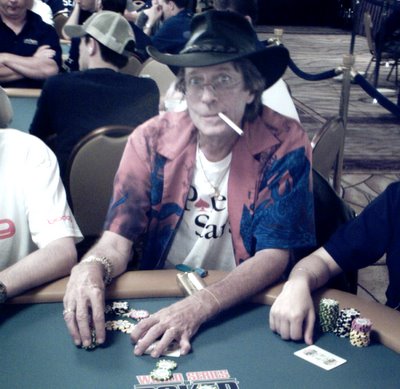
Speaking of mugging for the camera, here's Minneapolis Jim Meehan hamming it up. Nice shirt, too!
And one for the guys, namely "Aussie" Sarah Bilney:

As you can see, Jennifer Tilly wasn't the only beautiful brunette drawing media attention. Oh, speaking of Jennifer:
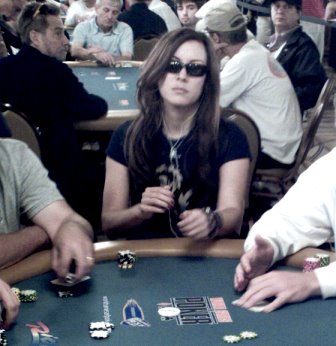
There. You can't accuse me of not catering to the audience. Oh, and since I mentioned the Mansion Poker Dome excursion, you know what you do in the hours before the taping starts? You stare at the walls, that's what. Not long before Nila the Nanny confiscated all our electronics, I snapped a photo of Tony G and his unofficial better half:

Yes, that's par for the course in a green room. In a phrase, boring as hell.
Time to wrap it up, this time with one of those "what the %&*^?" moments. My last eight days in Vegas were spent bouncing between the activities at the WSOP and my room at the Gold Coast, next door, where I collapsed each night. One thing that I discovered --- there's apparantly a thriving black market for used small appliances. How else can one explain this:
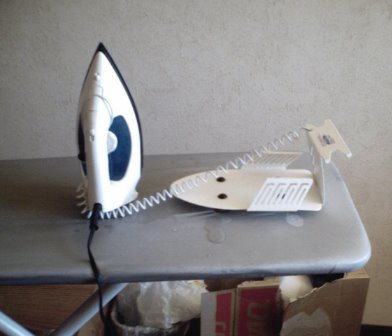
Yes, this cheap iron is literally bolted to the ironing board; you ain't going nowhere with this Sunbeam, baby. Given the makeup of the Pai Gow players downstairs, I suspect this rampant iron-theft racket is a Yakuza thing.
Nahh, just kidding, at least the the Yakuza bit. (Black-market Brauns have a higher resale value.) Though the Gold Coast is convenient, it's also more than a bit run down; my room featured any number of things which didn't work or weren't as advertised, from a tub that wouldn't drain to an out-of-focus TV to free 'Net access... that wasn't. (And I recounted the horrors of the Gold Coast poker "room" in one of my first Vegas-themed posts, early last month.) All I can say about the Gold Coast is that it was a necessary evil, providing convenient and nearby access to the WSOP happenings across the street.
While I've yet to see a final summary posted on the web, it's safe to say that a significant percentage of all the WSOP Main Event entrants won their seats online, certainly several thousands of the 8,773 ME participants. Players who qualified through the largest sites, such as Poker Stars, Bodog, or Full Tilt, also had special access to the hospitality suites that ringed the Amazon Room and the action itself.
Most of the suites were split into two parts, a public-access area toward the front and a more-exclusive, players/staff section at the back. In most cases the semi-private players' lounges were designed to allow the biggest of the sites' endorsers a convenient spot to relax, talk, eat, play some cards --- in general, to just get off the floor for a bit. Of those suites that were closest to the action, Full Tilt's had the most style, as can be seen here:

A nice setup, tastefully classy, as compared to Bodog's back area, which was more like one of those dimly-lit, crimsom-appointed '70s-era singles lounges that, thank the forces that be, no longer populate the landscape in quite as huge numbers. (Which doesn't mean I wasn't expecting to see Calvin Ayre look-alikes in white disco jumpsuits, complete with hairy chests and cheesy bling. Thankfully, that was just a hallucination.)
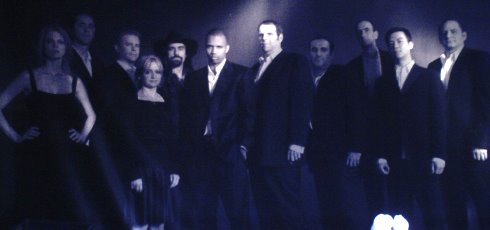
Barely visible in the Full Tilt Poker photo above is the back-wall mural, which built upon that 'Fremont St. Gang' ad concept that Full Tilt has used for some time. Here's what that looked like, though this photo does not capture the scope of the work:
Of course, you might have the impression that these lounges were deserted, but although they closed in the early evening, that wasn't the case. Each had the usual looker traffic, day after day, and the players, especially after being knocked out of other events, often played their own cash games in the back. Andy Bloch took a break from a cash game in the Full Tilt area to pose for this cheap-camera shot:
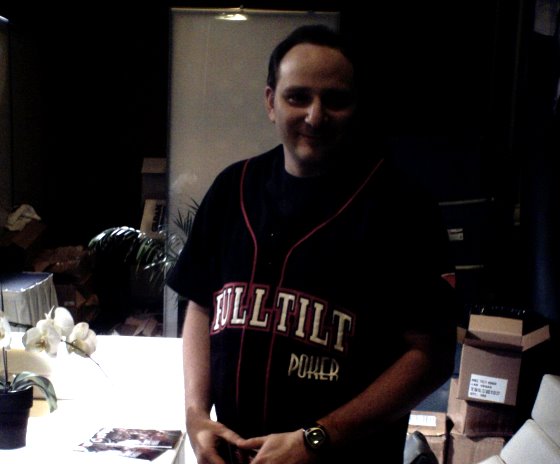
One of the reasons I like this photo, poor quality aside, is that despite the cavernous nature of the Rio Convention Center, space can still a be a premium on the small scale. All those boxes full of promotional goodies and hospitality-suite decorations have to go somewhere, don't they? And though they might be obscured from the general public's view, rest assured that for everyone --- not just Full Tilt --- the clutter was just out of sight.
Moving on.
If you want to see the famous faces of the poker world, well, there's no place like (the) Rio in July. You've probably noticed a sprinkling of photos in past posts, but I didn't take that many poker-star shots; other tasks had greater priority. Still, here's a few for your entertainment...
Here's Gavin Smith and Joe "Spidey" Sebok on the last of the four Day Ones of the Main Event, part of the payoff in a rather famed bet between the two. Too bad I missed the "bear in a diaper" day, but then again, it could have been worse --- imagine Joe in a "Wonder Woman" costume or something. Ick. Anyhow:

Speaking of mugging for the camera, here's Minneapolis Jim Meehan hamming it up. Nice shirt, too!
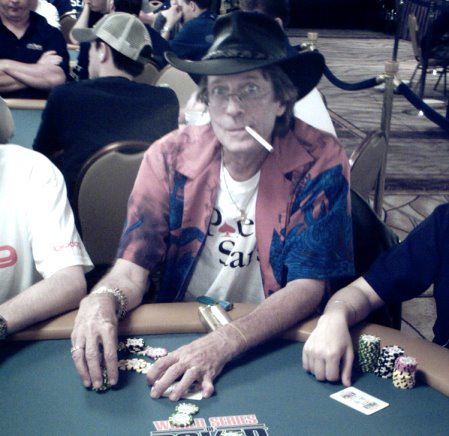
And one for the guys, namely "Aussie" Sarah Bilney:
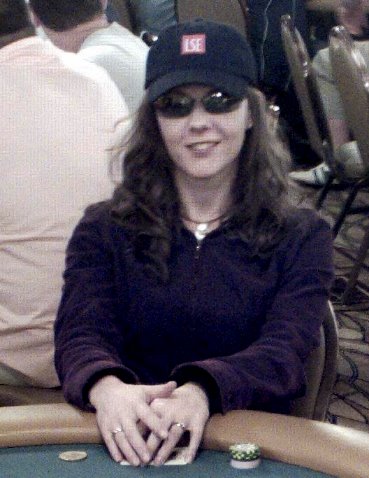
As you can see, Jennifer Tilly wasn't the only beautiful brunette drawing media attention. Oh, speaking of Jennifer:
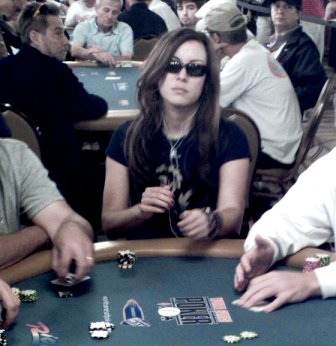
There. You can't accuse me of not catering to the audience. Oh, and since I mentioned the Mansion Poker Dome excursion, you know what you do in the hours before the taping starts? You stare at the walls, that's what. Not long before Nila the Nanny confiscated all our electronics, I snapped a photo of Tony G and his unofficial better half:

Yes, that's par for the course in a green room. In a phrase, boring as hell.
Time to wrap it up, this time with one of those "what the %&*^?" moments. My last eight days in Vegas were spent bouncing between the activities at the WSOP and my room at the Gold Coast, next door, where I collapsed each night. One thing that I discovered --- there's apparantly a thriving black market for used small appliances. How else can one explain this:
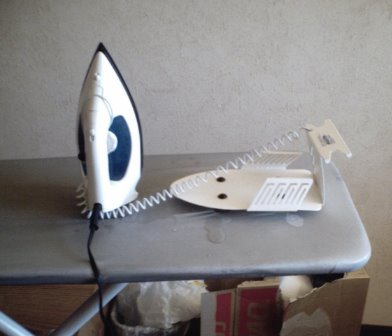
Yes, this cheap iron is literally bolted to the ironing board; you ain't going nowhere with this Sunbeam, baby. Given the makeup of the Pai Gow players downstairs, I suspect this rampant iron-theft racket is a Yakuza thing.
Nahh, just kidding, at least the the Yakuza bit. (Black-market Brauns have a higher resale value.) Though the Gold Coast is convenient, it's also more than a bit run down; my room featured any number of things which didn't work or weren't as advertised, from a tub that wouldn't drain to an out-of-focus TV to free 'Net access... that wasn't. (And I recounted the horrors of the Gold Coast poker "room" in one of my first Vegas-themed posts, early last month.) All I can say about the Gold Coast is that it was a necessary evil, providing convenient and nearby access to the WSOP happenings across the street.
Friday, September 22, 2006
Product Placement Meets Poker World on CBS
 Product placement in movies and TV is one of those long-standing traditions that dates all the way back to the 1920's, when advertising execs first grasped the idea that these new mediums could help increase a given product's visibility, along with an implied endorsement, even if nothing specific was ever said. Most people know the most famous big-screen examples, from James Bond's Astin Martin to Austin Powers's nod-'n'-a-wink bit with Pizza Hut, from the Marlboro-puffing aliens in Men In Black to one of the all-time beauts, the Reese's Pieces used to bait and trap E.T: The Extra-Terrestrial.
TV's the same story, most prevalent in the pre-packed foods you'll see lining the kitchen tables and fridge tops of sitcoms across the land. If it's not that, it's those living-room and business-office walls are always filled with old movie and concert posters and other commercial art --- there are a couple of firms that market that stuff exclusively, and purchasing placement spots is one of their main advertising streams.
I mean, an old Plan 9 From Outer Space poster is cool, but only on TV does anyone over the age of 25 find it a useful part of living-room decor.
It was only a matter of time until the burgeoning poker world would see product placement as a means of attracting visibility, and while it may have occurred previously, I haven't seen any mention of it, and I only noticed it myself this Monday past. The show was "Two and a Half Men" on CBS, where the Charlie Sheen character, Charlie Harper, chews up the better part of a long living-room scene, reading a very upright and prominently displayed Card Player as he trades witty rejoinders with his brother, Alan (Jon Cryer).
Judging by the length and blatancy of the pimp, Card Player ponied up some good bucks for this ad buy. And in case you're wondering, they went the easy-to-recognize route for the cover photo as well, choosing the recent Doyle Brunson cover pictured above.
I'm not surprised by it, of course; I just think it's rather neat. It's certainly an improvement over CP's ham-handed "Where in the World?" monthly feature, where readers lug their beloved CP to all sorts of ridiculous spots, a schtick that still has fathoms to go before catching the once-popular "XXXX miles to Wall Drug" or Burma-Shave signs on America's all-time list of stupid, commercial-driven fads. Ever been to Wall, South Dakota, home of the aformentioned uber-cheesy tourist trap? Hey, if you're on way to the Black Hills (with a stop at a Deadwood cardroom always an option), then the quick detour into Wall is really something you ought to do. And then hit the oppposite side of the interstate for the trip into the Badlands, just to clear your head.
Serious poker content? Not today, not today. But check back soon.

(Image sources: cardplayer.com, walldrug.com)
Sunday, September 17, 2006
WSOP Memories: The Pooh Pretzel Card Protector
Too busy of a week again to do the long trip down memory lane, so we'll wrap up another week with this:
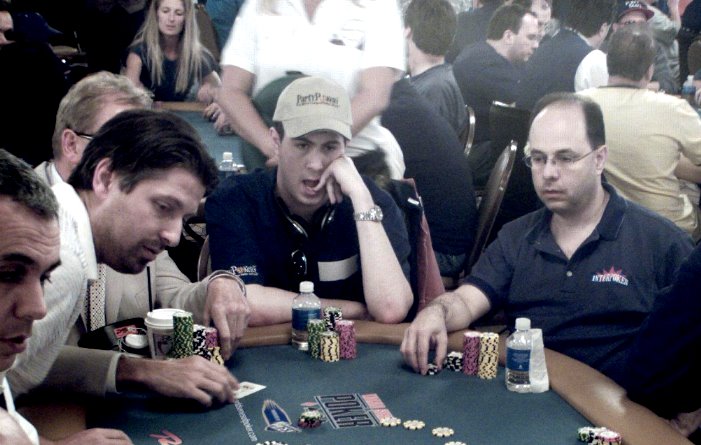
There were a lot of str-r-r-range card protectors floating around the tables during the WSOP's Main Event, but this one was certainly up near the top. I might not have noticed it all if not for the high-pitched shrieks and cackles of Mark Zadjner, pictured between the partly obscured Marcel Luske and Robert Varkonyi [photo at bottom of post], during earlier play.
Zadjner's shrieks drew dozens of people to the table to view... umm... that. "It's the funniest thing I've ever seen!" And more high-pitched howling, as Zadjner snapped open his cel phone and was off to wherever he went on breaks, but always at breakneck speed.
Ah, to have that energy level again....

There were a lot of str-r-r-range card protectors floating around the tables during the WSOP's Main Event, but this one was certainly up near the top. I might not have noticed it all if not for the high-pitched shrieks and cackles of Mark Zadjner, pictured between the partly obscured Marcel Luske and Robert Varkonyi [photo at bottom of post], during earlier play.
Zadjner's shrieks drew dozens of people to the table to view... umm... that. "It's the funniest thing I've ever seen!" And more high-pitched howling, as Zadjner snapped open his cel phone and was off to wherever he went on breaks, but always at breakneck speed.
Ah, to have that energy level again....
Per Frist, We Can't Armor the Humvees, But We Can Include Online Gaming as a 'National Defense' Interest
In case you haven't heard, Sen. Bill Frist (R-TN), the U.S. Senate Majority Leader, ran into a wall in his efforts to push straightforward legislation outlawing Internet gambling through the Senate. This was no surprise, given that the support for such a measure pretty much stopped at the boundaries of the conservative right, with a few add-ins from groups such as the NFL (which consistently seeks to eliminate all forms of betting on NFL games), and a couple of groups interested in promoting their own nanny-society, and special-interest (re: Indian gaming) beliefs. So it didn't work as Frist had hoped, nor was it likely to.
Never doubt, though, that the good Senator has far more nefarious plans --- and in this case, they're more than a bit disgusting.
 Frist's latest ploy, according to several published reports, is to backdoor his version of the anti-gambling legislation onto an upcoming Defense appropriations bill, which anyone with a sense of American-born dignity and value should find nausea-inducing, at the least. That Frist attempts these things all the time should come as no surprise; his highly polished persona softens the fact that he's always been about two things: image and money.
Under closer examination, Frist's latest maneuvers with the anti-gambling legislation now seem to be part of a greater ploy --- to cement his status as the leading Presidential candidate of the fervent political right as the Iowa caucauses approach. He's looking for specific hooks upon which to hang his claim as the defender of all things right and decent... as defined by those rather conservative groups. And as mentioned, Frist's beliefs about proper Defense appropriations have little to do with anything but the bottom line: he cast an important vote against a $213 Million supplementary appropriations bill designed to armor besieged Humvees, in April of 2005.
Frist has always been about the money and the pandering, and it's where his own ethics have most often been in question. The online site Beyond Delay lists him as one of the 13 most corrupt members of Congress, in large part because of a million-dollar scheme designed to funnel campaign donations into the stock market to generate additional revenue. Problem is, that one ran into a bit of bad luck --- the market actually dipped, and the surreptitious investment lost money. The Frist solution? They resurrected the dormant 1994 campaign-fund committee, arranged for a $1.44 million loan with the 1994 and 2000 campaign funds as co-recipients (though as you can imagine, the 2000 fund got the money). Then, the erstwhile Friends of Frist, or whatever they call it, retroactively reported the loan on the all-but-historical '94 campaign-fund reports, and omitted them from the 2000 legal campaign reports as made to the Federal Election Committee, a clear work-around of campaign requirements.
We won't even get into the scandal involving the dumping of stock by Frist, part of his holdings in a large, private hospital chain owned byhis family (H.C.A., Inc., the nation's largest such chain), a month prior to that company's stock diving 10% on a very weak earnings report. (Frist was a wealthy physician before entering politics.) Let's just say that this one puts Martha Stewart to shame.
This isn't intended to be a character-assassination piece. Rather it's intended to clarify for readers here exactly who this opponent is --- an angle shooter of such skills as to put the Mike Matusows and Jamie Golds of the world in the "pale imitator" class. Frist is very good. Very smooth.
And very, very powerful, in that soulless, political way.
This one's not about right or wrong; it's about image, about Frist trying to shape himself as a defender and an upholder and a true believer, and it's clear that common decency and such considerations need not be a concern, when the greater aspirations of a Presidential hopeful are at stake.
So spread the word. By shining as much light as possible at the extent of Frist's shenanigans, he'll be pressured to de-couple the anti-Internet gambling debate from those other, far more important Defense concerns. Let the anti-Internet gambling issue stand or fall on its own merits, or lack thereof.
But tying it to a Defense bill is sick. Shame on you, Senator Frist.
Never doubt, though, that the good Senator has far more nefarious plans --- and in this case, they're more than a bit disgusting.
 Frist's latest ploy, according to several published reports, is to backdoor his version of the anti-gambling legislation onto an upcoming Defense appropriations bill, which anyone with a sense of American-born dignity and value should find nausea-inducing, at the least. That Frist attempts these things all the time should come as no surprise; his highly polished persona softens the fact that he's always been about two things: image and money.
Under closer examination, Frist's latest maneuvers with the anti-gambling legislation now seem to be part of a greater ploy --- to cement his status as the leading Presidential candidate of the fervent political right as the Iowa caucauses approach. He's looking for specific hooks upon which to hang his claim as the defender of all things right and decent... as defined by those rather conservative groups. And as mentioned, Frist's beliefs about proper Defense appropriations have little to do with anything but the bottom line: he cast an important vote against a $213 Million supplementary appropriations bill designed to armor besieged Humvees, in April of 2005.
Frist has always been about the money and the pandering, and it's where his own ethics have most often been in question. The online site Beyond Delay lists him as one of the 13 most corrupt members of Congress, in large part because of a million-dollar scheme designed to funnel campaign donations into the stock market to generate additional revenue. Problem is, that one ran into a bit of bad luck --- the market actually dipped, and the surreptitious investment lost money. The Frist solution? They resurrected the dormant 1994 campaign-fund committee, arranged for a $1.44 million loan with the 1994 and 2000 campaign funds as co-recipients (though as you can imagine, the 2000 fund got the money). Then, the erstwhile Friends of Frist, or whatever they call it, retroactively reported the loan on the all-but-historical '94 campaign-fund reports, and omitted them from the 2000 legal campaign reports as made to the Federal Election Committee, a clear work-around of campaign requirements.
We won't even get into the scandal involving the dumping of stock by Frist, part of his holdings in a large, private hospital chain owned byhis family (H.C.A., Inc., the nation's largest such chain), a month prior to that company's stock diving 10% on a very weak earnings report. (Frist was a wealthy physician before entering politics.) Let's just say that this one puts Martha Stewart to shame.
This isn't intended to be a character-assassination piece. Rather it's intended to clarify for readers here exactly who this opponent is --- an angle shooter of such skills as to put the Mike Matusows and Jamie Golds of the world in the "pale imitator" class. Frist is very good. Very smooth.
And very, very powerful, in that soulless, political way.
This one's not about right or wrong; it's about image, about Frist trying to shape himself as a defender and an upholder and a true believer, and it's clear that common decency and such considerations need not be a concern, when the greater aspirations of a Presidential hopeful are at stake.
So spread the word. By shining as much light as possible at the extent of Frist's shenanigans, he'll be pressured to de-couple the anti-Internet gambling debate from those other, far more important Defense concerns. Let the anti-Internet gambling issue stand or fall on its own merits, or lack thereof.
But tying it to a Defense bill is sick. Shame on you, Senator Frist.
Saturday, September 16, 2006
From the Police Blotter...
At last! It's a sprightly return to one of those very "occasional" recurring features, wherein we return to the theme of cops --- usually at the behest of overzealous, right-pandering D.A.'s --- showing us all yet again that the private, small-stakes poker game is a Menace To Society. In truth it's not always that, but one thing is for sure: Whenever a small poker game is raided, it's because somebody else wants to make a point, even if that point is revenge.
I love 'em, those moralistic, get-even or get-ahead types. Well, no, not really.
Stop #1 takes us to a story that John Caldwell just broke over at pokernews.com, wherein the cops in Greenville, SC last week raided a private home game with a $100 buy-in, based on a law that had been on the books for over a hundred years (and has, you can safely wager, but only for fun), rarely been enforced. According to the report, the cops not only kicked down the door, they made the players lie down on the floor while arresting them.
 What? No dogs? No S.W.A.T. team? Someone's going to have to pay for that oversight.
Stop #2 takes us to this little item from the Toledo Blade, where 24 poker players were arrested or charged with --- *gasp!* --- more gambling. A 40-year-old Steve Lang admitted to organizing the game, and was thereupon arrested for "running a gambling house," and two others were also arrested. The other 21 seem to have been issued court summonses for lesser offenses. And the total take from the search and seizure? $4,500. This after a three-month investigation into the game, based on an informer's tip. No report as to whether any doors were kicked down here, but the article specifically mentions the seizure of cards, chips, and "surveillance equipment." Sounds like the game was run in the back of somebody's small-business building.
Geez, but that's a good use of enforcement resources, isn't it? The problem is, these games never get bothered until someone makes a complaint, and then, because the laws are on the books, antiquated though they are, the police have to investigate.
The greater lesson? When you're at a private game, know who you're playing with.
Good thing I don't play poker --- I just write about it.
I love 'em, those moralistic, get-even or get-ahead types. Well, no, not really.
Stop #1 takes us to a story that John Caldwell just broke over at pokernews.com, wherein the cops in Greenville, SC last week raided a private home game with a $100 buy-in, based on a law that had been on the books for over a hundred years (and has, you can safely wager, but only for fun), rarely been enforced. According to the report, the cops not only kicked down the door, they made the players lie down on the floor while arresting them.
 What? No dogs? No S.W.A.T. team? Someone's going to have to pay for that oversight.
Stop #2 takes us to this little item from the Toledo Blade, where 24 poker players were arrested or charged with --- *gasp!* --- more gambling. A 40-year-old Steve Lang admitted to organizing the game, and was thereupon arrested for "running a gambling house," and two others were also arrested. The other 21 seem to have been issued court summonses for lesser offenses. And the total take from the search and seizure? $4,500. This after a three-month investigation into the game, based on an informer's tip. No report as to whether any doors were kicked down here, but the article specifically mentions the seizure of cards, chips, and "surveillance equipment." Sounds like the game was run in the back of somebody's small-business building.
Geez, but that's a good use of enforcement resources, isn't it? The problem is, these games never get bothered until someone makes a complaint, and then, because the laws are on the books, antiquated though they are, the police have to investigate.
The greater lesson? When you're at a private game, know who you're playing with.
Good thing I don't play poker --- I just write about it.
Are Poker Blogs Dying?
The "sky is falling" sentiment hidden in above is a topic for discussion this week, as several poker bloggers have posted about the recent dearth of new posts by many of the blogging world's most well-known pokerists ("pokerists" being something like "shootists," I guess), plus the moving on to other pastures of one or two big names. There's no doubt that poker blogs are in a state of transition.
But dying? Mercy, no.
Two processes seem to be at work here, combining to make all of poker-bloggerdom look a bit unsettled at the moment. One is the naturally high turnover that poker blogs and bloggers suffer. Folks start a blog with good intentions, and poker blogs are wryly reminiscent of the wit who once opined that there are two types of songs --- those that are about sex, and those that aren't. In terms of poker blogs, the split is between those that are diaries about one's own poker game and experiences, and those that are largely about other things, usually the life and world of poker.
 Most people find the first type of poker blog a bit boring and tedious after a while, unless the blogger/player is exceptionally talented or has other things to share. Rizen (Eric Lynch) and Doubleas (Scott Gallant) are two exceptional examples of this type of blog --- each has grown, thrived, and prospered. But most people aren't Rizen or Scott, and so they hit a wall, with few readers and not much new to say to those who visit. So the blogs wither and die.
It happens in clumps, though, this secondary die-off. Most bloggers become part of a localized group of friends, sharing links and swapping stories, and when small groups like this lose a few members in short order, than it's like the loss of critical mass to that group. What's not realized, however, when you're in one of the groups, is that other, new groups are constantly forming and emerging. And these blogs will be every bit the same (wry smile, here) --- some will be about poker-sex(!) and some won't. And some will live and prosper, while others will soon be forgotten.
And that's all just the first half.
Second, and perhaps more important in the long run, is the emergence of several compendium blogs. The biggest and splashiest of these has to be the efforts at PokerBlog.com, which now features entries from several big poker-writing names, many of whom use the site to cross-post from their own blogs as well. Compendium blog-style sites, even in poker, aren't new; other examples include The Card Squad, Up For Poker, Wicked Chops, Linda Geenen's Poker Works, and at least a couple of others. Think of them as the airline "hub" cities of the poker-blogger world.
The reasons for their evolution and emergence are easy to see. First of all, the combining of content under a single site is very pitchable to outside sponsors. Second, it's easy to attract big names (even player-types who don't write very much), who know they don't have to carry the whole load on the site. Third, it's an easy way to leverage and separate the compendium site from the sea of more modest blogs, good or bad. Readers don't really save clicks, but they save the work of investing those clicks into something that might not be worth the effort. The best compendium sites have a well-established bottom line for quality; visitors can almot always count on finding something new that's worth the read.
Compendium blogs aren't just here to stay; they're only going to get more prominent, because the logic of the poker-blog market --- and yes, it IS a market --- demands that a new format adds additional structure to an otherwise all-but-unsurfable sea. That said, the best of the single-person independent voices and sites will never go away, because that's part of poker blogging, too.
Nor is poker blogging dying. Individual poker blogs die all the time, but there are hundreds of them out there, perhaps as many as a thousand. More poker blogs than ever before. Poker, poker, poker...
You get the point.
But dying? Mercy, no.
Two processes seem to be at work here, combining to make all of poker-bloggerdom look a bit unsettled at the moment. One is the naturally high turnover that poker blogs and bloggers suffer. Folks start a blog with good intentions, and poker blogs are wryly reminiscent of the wit who once opined that there are two types of songs --- those that are about sex, and those that aren't. In terms of poker blogs, the split is between those that are diaries about one's own poker game and experiences, and those that are largely about other things, usually the life and world of poker.
 Most people find the first type of poker blog a bit boring and tedious after a while, unless the blogger/player is exceptionally talented or has other things to share. Rizen (Eric Lynch) and Doubleas (Scott Gallant) are two exceptional examples of this type of blog --- each has grown, thrived, and prospered. But most people aren't Rizen or Scott, and so they hit a wall, with few readers and not much new to say to those who visit. So the blogs wither and die.
It happens in clumps, though, this secondary die-off. Most bloggers become part of a localized group of friends, sharing links and swapping stories, and when small groups like this lose a few members in short order, than it's like the loss of critical mass to that group. What's not realized, however, when you're in one of the groups, is that other, new groups are constantly forming and emerging. And these blogs will be every bit the same (wry smile, here) --- some will be about poker-sex(!) and some won't. And some will live and prosper, while others will soon be forgotten.
And that's all just the first half.
Second, and perhaps more important in the long run, is the emergence of several compendium blogs. The biggest and splashiest of these has to be the efforts at PokerBlog.com, which now features entries from several big poker-writing names, many of whom use the site to cross-post from their own blogs as well. Compendium blog-style sites, even in poker, aren't new; other examples include The Card Squad, Up For Poker, Wicked Chops, Linda Geenen's Poker Works, and at least a couple of others. Think of them as the airline "hub" cities of the poker-blogger world.
The reasons for their evolution and emergence are easy to see. First of all, the combining of content under a single site is very pitchable to outside sponsors. Second, it's easy to attract big names (even player-types who don't write very much), who know they don't have to carry the whole load on the site. Third, it's an easy way to leverage and separate the compendium site from the sea of more modest blogs, good or bad. Readers don't really save clicks, but they save the work of investing those clicks into something that might not be worth the effort. The best compendium sites have a well-established bottom line for quality; visitors can almot always count on finding something new that's worth the read.
Compendium blogs aren't just here to stay; they're only going to get more prominent, because the logic of the poker-blog market --- and yes, it IS a market --- demands that a new format adds additional structure to an otherwise all-but-unsurfable sea. That said, the best of the single-person independent voices and sites will never go away, because that's part of poker blogging, too.
Nor is poker blogging dying. Individual poker blogs die all the time, but there are hundreds of them out there, perhaps as many as a thousand. More poker blogs than ever before. Poker, poker, poker...
You get the point.
Monday, September 11, 2006
Season Three of the Kick Ass Poker Online League Starts Sep. 20
 Yes, it's just like "24" --- seasons in poker leagues don't have to be a once-a-year thing. So it holds with the upcoming third season of Kick Ass Poker's online poker league, which continues its tour of sponsoring league sites by moving over to Mansion Poker for the fall's fun.
Are you going to join the fun? Check the links, see what's in store... you'll find that in addition to the usual cash prizes, Mansion is tossing in a number of juicy bonuses that make this one a shouldn't-miss event.
The entry fees for each of the weekly events are modest, and the fields are comfortably small; you'll get to meet several decent-'n'-dedicated Atlanta-area players, a handful of outside (but always welcome) interlopers, and at least one roving donkey with previous Poker Dome experience. And yes, seats to one of the Poker Dome online qualifiers are among the nice bonus prizes available here.
 So whaddya need to do? Well, if you don't have a Mansion Poker account, that'd be a good first step. I do believe that the KAP brain trust has teamed up with Mansion to offer one of the best sign-up bonuses found anywhere for the site, and, well, let's just say that if you're going to play, you might as well force yourself to accept a few bonus dollars for your troubles. Or more than a few. It's up to you to decide.
After that, just sneak on over to the KAP Online League registration form, which allows the password to be mailed to you for each of the weekly events, fill it out --- it's very short --- and do the happy-click thing to send it in. The league is open to everyone, but you do have to register.
After that, it's on to the easiest part of all: taking my money and winning the accolades of your fellow KAP Online Leaguers. (The two, of course, are intertwined.) I'll see you there, but only if you're quick... my chips won't last long.
Sunday, September 10, 2006
Sunday Nite WSOP Photo Mini-Dumplet
And not even from the WSOP itself, on this one. That's what happens when real poker news picks up, as it has this past week. While there's still plenty of Mansion Poker Dome and WSOP tales in store, we'll just wrap things up for the night with this:

Given that Mondays are not the quietest day of the week at Las Vegas's McCarren International Airport, one wonders on the wisdom of shooting the airport scenes for Oceans 13 that day. Uh, yep --- I ran into a bit of a snarl in the terminal on my way back to the Midwest, and this photo only captures about a tenth of the crowd that hovered outside the set barriers.
Funny. All those folks that getting a picture of Matt Damon was a big deal. I thought getting a picture of them was a far more entertaining bit.

Given that Mondays are not the quietest day of the week at Las Vegas's McCarren International Airport, one wonders on the wisdom of shooting the airport scenes for Oceans 13 that day. Uh, yep --- I ran into a bit of a snarl in the terminal on my way back to the Midwest, and this photo only captures about a tenth of the crowd that hovered outside the set barriers.
Funny. All those folks that getting a picture of Matt Damon was a big deal. I thought getting a picture of them was a far more entertaining bit.
Milwaukee's Best Light Offers "PC" WSOP Promotion
Here's the tale of a poker-themed press release where you can smell the political pandering in the very first phrase. Surely, I jest? I think not; judge for yourself:
"Poker Creations, the leader in US-compliant online poker promotion tournaments...:
Yeah. It's always good when you start with the spin, rather than introducing it sometime after the matter at hand itself. What this release actually deals with is Milwaukee's Best Light Beer, one of the big corporate sponsors of the WSOP, coming back with a second year of their own in-house WSOP promotion. In this year's version, seven fully paid seats into the 2007 WSOP Main Event will be awarded, but after reading the release, I don't think I'll be trying for any of these seats... or drinking any Beast Light.
But it's how Milwaukee's Best Light serves this one up that gets my goat. Here's a bit more from the contest announcement:
 "According to the New York Times, there are more than 65 million poker players in the US. But, live-money Internet poker sites are considered illegal. The US House of Representatives recently adopted HR4777, 'The Internet Gaming Prohibition Act'. This combined with US Attorneys arresting a UK-based sportsbook CEO, have caused US-based brand owners and media properties to re-evaluate how to align themselves with this burgeoning new audience."
Wow. So, to further promote Year Two of a contest that they were going to run anyway, Beast Light tosses its corporate hat into the "online poker is illegal" crowd, infers that the House bill has actually become law (it hasn't), and basically does everything it can do smear the general competition.
Promotions are supposed to be about good times and values, not about fear and divisiveness, and since the Beast Light game takes place on the Internet, they're starting out by alienating a large part of Beast Light's presumed target audience --- people willing to play poker on their computers. But, somehow, the asshats at Poker Creations and Beast Light don't seem to be able to think about that one --- they'd rather try to frighten people into drinking their cheap beer.
That's what cowardice will do.
"Poker Creations, the leader in US-compliant online poker promotion tournaments...:
Yeah. It's always good when you start with the spin, rather than introducing it sometime after the matter at hand itself. What this release actually deals with is Milwaukee's Best Light Beer, one of the big corporate sponsors of the WSOP, coming back with a second year of their own in-house WSOP promotion. In this year's version, seven fully paid seats into the 2007 WSOP Main Event will be awarded, but after reading the release, I don't think I'll be trying for any of these seats... or drinking any Beast Light.
But it's how Milwaukee's Best Light serves this one up that gets my goat. Here's a bit more from the contest announcement:
 "According to the New York Times, there are more than 65 million poker players in the US. But, live-money Internet poker sites are considered illegal. The US House of Representatives recently adopted HR4777, 'The Internet Gaming Prohibition Act'. This combined with US Attorneys arresting a UK-based sportsbook CEO, have caused US-based brand owners and media properties to re-evaluate how to align themselves with this burgeoning new audience."
Wow. So, to further promote Year Two of a contest that they were going to run anyway, Beast Light tosses its corporate hat into the "online poker is illegal" crowd, infers that the House bill has actually become law (it hasn't), and basically does everything it can do smear the general competition.
Promotions are supposed to be about good times and values, not about fear and divisiveness, and since the Beast Light game takes place on the Internet, they're starting out by alienating a large part of Beast Light's presumed target audience --- people willing to play poker on their computers. But, somehow, the asshats at Poker Creations and Beast Light don't seem to be able to think about that one --- they'd rather try to frighten people into drinking their cheap beer.
That's what cowardice will do.
Guaranteed Tourneys --- Hidden Value on the Smaller Sites
Can you say "overlay?" Welcome to Sunday Truism School, and here's the morning lesson:
Small, new sites, in the pursuit of name recognition and market share, are consistent in one thing --- they offer great values to those adventurous enough to risk a few bucks with a not-qute-sure thing.
Most often, the customer has to put up with a lack of traffic, too, but that's often what makes the guarantee tourneys the preferable deal. After, that's one of the hidden banes of online bonuses, no matter what the site: it quite often turns out that the conditions, games and traffic flow necessary to complete the bonus requirements just don't exact in any real form. A 300% bonus to $10,000? Sure --- and we'll credit you one point for every hand played and raked at $2/4 and above, and release a dollar every 100 points, and you'll even find enough players to fill a single table from 6-8pm on Tuesday eves.
Oh, and the offer expires after 30 days.
It's because of this that I tend to look less and less at the dollar values of the site offers, and more and more at the traffic and the tournament guarantees. But there's a catch: the best values aren't on the smallest sites, but rather, the small independent ones. It's the key distinction.
I've spent some time on three sites that fit into this category lately, Mansion Poker, Tony G Poker and poker.com. All are independent sites, not part of a larger family like the Tribeca or Microgamimg networks. Interestingly, Mansion Poker and Tony G Poker are sites that you'd swear were skins of some larger corporation; they've obviously gotten their software from the same source. But they aren't skins on a larger network, at least as far as I can determine --- each is a new, independent entity.
Now, I've mentioned previously that they are some great, great tournament values on Mansion, and I'll point out another example today from Tony G. Here's a screengrab I took from a tournament I played this morning:
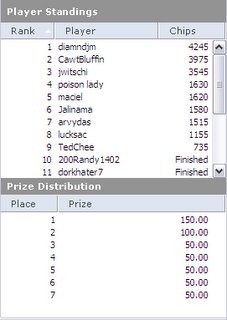
It tells you not too much without explanation, but note that strangely flat prize structure. Weird? Well, it was a $500 Guarantee "speed" tourney with a $20+2 entry. And it gathered 20 entrants, for a pool of $400 paid, which meant that the $500 paid out was a 25% overlay.
And it paid seven places, of 20 entries, meaning a better than 1-in-3 chance of cashing.
This is normal on these new, independent sites. It is, in the technical parlance, +EV. And this is where you can build bankroll, even if you are, as I am, a poker player of modest means and skills. (I'd also like to point out that the "speed" tag is a misnomer; the software setup used by Mansion and Tony G includes the slowest-increasing tournament structure I've yet encountered on an online site. This means that "speed" tourneys here play like regular ones elsewhere, and regular ones here are a real test of poker patience.)
Is there a hidden downside? I'm not sure --- though I do wonder on occasion about server connectivity and network stability. I'm in the midst of the worst weekend of bad-timed disconnections of my poker life, and I'm about to throw my computer through the wall. And yes, the problem is as much on my end, or moreso, as it is with the servers that drive these networks. I say this despite this weekend's network adventures having cost me not one, but three chances at big paydays --- there's nothing worse than waiting to come over the top with an all-in, over-the-top reraise (when you know you'll get two callers), holding aces in the pocket and having aces full made with the board, and everything freezes. In a $10,000 freeroll with only a few hundred players, with lots of donkeys at hand, two of whom then crack your pocket kings, on consecutive hands, when your connection does come back. This happened to me today on poker.com. And yes, I'm on tilt --- I won't play any more poker today.
But I wander, in the midst of my steam bath. The point is that these tournaments, on these small independent sites, offer exceptional values, far more than you're likely to find on the 138th Tribeca skin, whatever that might happen to be.
Pay less attention to the dollars of the bonus offers, and more attention to the opoortunities that the traffic (or lack thereof) creates. Great values await.
Small, new sites, in the pursuit of name recognition and market share, are consistent in one thing --- they offer great values to those adventurous enough to risk a few bucks with a not-qute-sure thing.
Most often, the customer has to put up with a lack of traffic, too, but that's often what makes the guarantee tourneys the preferable deal. After, that's one of the hidden banes of online bonuses, no matter what the site: it quite often turns out that the conditions, games and traffic flow necessary to complete the bonus requirements just don't exact in any real form. A 300% bonus to $10,000? Sure --- and we'll credit you one point for every hand played and raked at $2/4 and above, and release a dollar every 100 points, and you'll even find enough players to fill a single table from 6-8pm on Tuesday eves.
Oh, and the offer expires after 30 days.
It's because of this that I tend to look less and less at the dollar values of the site offers, and more and more at the traffic and the tournament guarantees. But there's a catch: the best values aren't on the smallest sites, but rather, the small independent ones. It's the key distinction.
I've spent some time on three sites that fit into this category lately, Mansion Poker, Tony G Poker and poker.com. All are independent sites, not part of a larger family like the Tribeca or Microgamimg networks. Interestingly, Mansion Poker and Tony G Poker are sites that you'd swear were skins of some larger corporation; they've obviously gotten their software from the same source. But they aren't skins on a larger network, at least as far as I can determine --- each is a new, independent entity.
Now, I've mentioned previously that they are some great, great tournament values on Mansion, and I'll point out another example today from Tony G. Here's a screengrab I took from a tournament I played this morning:
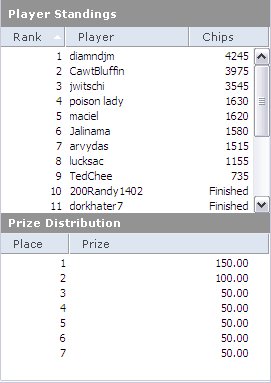
It tells you not too much without explanation, but note that strangely flat prize structure. Weird? Well, it was a $500 Guarantee "speed" tourney with a $20+2 entry. And it gathered 20 entrants, for a pool of $400 paid, which meant that the $500 paid out was a 25% overlay.
And it paid seven places, of 20 entries, meaning a better than 1-in-3 chance of cashing.
This is normal on these new, independent sites. It is, in the technical parlance, +EV. And this is where you can build bankroll, even if you are, as I am, a poker player of modest means and skills. (I'd also like to point out that the "speed" tag is a misnomer; the software setup used by Mansion and Tony G includes the slowest-increasing tournament structure I've yet encountered on an online site. This means that "speed" tourneys here play like regular ones elsewhere, and regular ones here are a real test of poker patience.)
Is there a hidden downside? I'm not sure --- though I do wonder on occasion about server connectivity and network stability. I'm in the midst of the worst weekend of bad-timed disconnections of my poker life, and I'm about to throw my computer through the wall. And yes, the problem is as much on my end, or moreso, as it is with the servers that drive these networks. I say this despite this weekend's network adventures having cost me not one, but three chances at big paydays --- there's nothing worse than waiting to come over the top with an all-in, over-the-top reraise (when you know you'll get two callers), holding aces in the pocket and having aces full made with the board, and everything freezes. In a $10,000 freeroll with only a few hundred players, with lots of donkeys at hand, two of whom then crack your pocket kings, on consecutive hands, when your connection does come back. This happened to me today on poker.com. And yes, I'm on tilt --- I won't play any more poker today.
But I wander, in the midst of my steam bath. The point is that these tournaments, on these small independent sites, offer exceptional values, far more than you're likely to find on the 138th Tribeca skin, whatever that might happen to be.
Pay less attention to the dollars of the bonus offers, and more attention to the opoortunities that the traffic (or lack thereof) creates. Great values await.
Friday, September 08, 2006
The (Mostly) Definitive Word on the WSOP Chip-Surplus Scandal
(Blogger's VERY IMPORTANT note: When reading this, you will encounter a couple of statements that when taken out of context or if used in an exploitative manner, would indicate that I believe that something untoward and dishonest occurred concerning the late stages of the WSOP. Let me assure anyone who reads this that is not so --- everyone who I observed at the WSOP appeared to me to be very efficient in what they were trained to do... and very honest. I did see one case of gross systemic incompetence, and I won't back away from that, even as several other episodes showing similar procedural horrors have also now come to light.
I do, sincerely, believe that the chip error that occurred at the WSOP was an honest mistake, although it's taken some further discussions with a couple of experts to convince me that one of the logic points I addressed --- the fact that several people would all have had to miss the same mistake at the same time, repeated across three different tables --- was a bit disbelievable on its face. This person reminded me that although the last few dealers were probably among the best at the WSOP, they could also be described, if rather harshly, as the best of a questionable batch. The really good, observant dealers, the ones likely to catch an error of this nature, simply wouldn't be working a temporary gig such as the WSOP. So these dealers were tired, at the end of an eight-week run, and so what? Who cares what the tournament director does with the chips?
But anyhow, back to my piece, and why this preface is now necessary. What follows --- and I'm not going to take it down, because its intent and its probing are worth the pixels --- was always intended to be a "devil's advocate" piece. Think an innocent mistake was what happened? Well, so do I. But the evidence so far uncovered does not disprove that something untoward might have happened, and that was THE point of the piece. It was intended to be a wake-up call, not an accusation.
I'm not a big conspiracy buff. I'm not much for Oliver Stone, and you know the World Trade Center attack? Osama and friends did it. "The DaVinci Code"? Balderdash... though I absolutely love looking at what's involved and seeing how such a crock can be built from a pile of mostly-true shards.
So keep that in mind when you read the following.
I tried to make the message of this clear, but now I'll just state it outright: It is incumbent upon Harrah's and the WSOP to own this mistake, to identify everything that they have learned about it, and to be forthright about what they do to prevent similar mistakes in the future. It is that important.
The mistake happened, it's part of history, and in all likelihood it is what is known as an "uncorrectable error" in major sports, like an extra foul shot being awarded. If Harrah's believes that this mistake was just going to curl up and die if they ignored it, then that represents the greater error, the gross misunderstanding of human nature and competitive glory and the fact, frankly, that there's a whole lot of money at stake. This is $88 million freaking dollars. It may be a mote on the Harrah's balance sheet, but hell, people also kill for the tiniest fraction of that amount, every day. The vast majority of each tournament's entrants are hopers and dreamers, many of them in what will turn out to be their own chance, albeit it very slim, at such riches and fame.
And to think that these people wouldn't clamor and scream and demand the proper and full explanation, after a two million chip mistake had been uncovered? If I were to have been in this, and somehow gone deep, I'd be outraged, indignant, merciless in pursuing something of this magnitude. It's just a tournament, yes, but that's human nature, too.
This is why I wrote what I did. It's not that I believe there was theft or malfeasance or dishonesty or any of that, because I don't. It was a message to Harrah's, in that by saying nothing and cowering in the corner for a month, Harrah's and the WSOP have done nothing but open the door to all sorts of outrageous rumors and accusations. I used the logic to add to what we already know to show that... wait, it's like a plane on the drawing board --- what we've been offered looks pretty but it still doesn't quite fly.
Conspiracies are ugly things. They build on themselves, wedging into the cracks and crevices of things that are known to be, where they grow, like fungus. It is important to recognize, though, that they serve a purpose: they can allow us to take a look at the process of moving from Point A to Point B (and points beyond), and coming up with some explanation, ludicrous or not, for whatever's occurred.
But, please, don't read all the following as an accusation. It's not. It's a wake-up call, to you-know-who.
Anyone who's kept track of the in-workings of the recently completed World Series of Poker is aware of the controversy involved with the chips during the last couple of days of play. And if you haven't, here's the short version: More than $2,000,000 in chips magically appeared somewhere during the late stages, swelling the total chips in play from just under $88 to more than $90 million. The surplus seems to be between 2.0 and 2.5 million chips, and we'll likely never know the exact overage that was introduced to the tables.
 There have been lots of explanations, theories, accusations... and of course, the usual unfocused grumbling. We had some of it here, in a episode I recounted from my own reporting time on the scene, when I saw lax chip security in a manner that would have allowed chips to be stolen and reintroduced into play, under certain circumstances. Flawed though it was, I surmised it to be the outgrowth of a long-standing tournament practice, one that had grown outmoded and untrustworthy under the strains of the present-day crowds, and I heven't seen anything that would make me change that assumption. Still, it's all probably beside the point.
Veteran poker writers Amy Calistri and Tim Lavalli have put together a wonderful expose on the matter, one of the best examples of poker reporting to hit our business in recent memory. You are highly encouraged to read it in its entirety over at pokernews.com; you'll be glad you did.
Now we get to put on the detective hat and do some additional thinking. First, I never believed the proferred explanations of (1) theft of chips from other tournaments which were then reintroduced in the Main Event, or (2) that the repeated process of coloring up and removing the smallest-denomination chips could explain the discrepancy; these were the two likeliest explanations offered. In the prior scenario, there was simply no way that someone could steal $2 million dollars in chips during play from other tournaments and have them reintroduced into the main event; this would involve repeated small-scale pilfering on a massive scale, somehow combining and coordinating all those thefts without word ever getting out, and is so unlikely as to be beyond all consideration. In the second scenario, as proved by Calistri's and Lavalli's work, the mathematics preclude beyond any doubt that the coloring-up process could account for more than a couple of percent of the overage.
It's also known that a few tens of thousands of chips were introduced to the Main Event through clerical and organizational error early on, but again, this accounted for perhaps $50,000 in chips, which was only one or two percent of the problem.
So, player theft was never a possibility, nor was the coloring up, in terms of the natural math of the process itself. It simply had to be a problem with Harrah's itself, whether through a flawed color-up process (the explanation offered by Calistri/Lavalli), or something else under the control of Harrah's. At over two million chips, the problem was too massive to have been caused by an individual player, at least in terms of the theft/re-introduction mentioned above. Which is where, of course, the Calistri/Lavalli piece comes in.
And that said, and having read and re-read their posited scenarios and explanations, I'm still not quite satisfied. The explanation Calistri and Lavalli offer fits the available data better than any other we've yet seen, but it still has some problems, which I'll do my best to address here.
There seems little doubt that Calistri and Lavalli have isolated the key moments when the improper chip introduction occurred, that being just prior or during the first break during Day 7 play, when the last of the $5,000 chips were being removed and replaced with higher denominations, mostly $25,000 (along with some $10,000) chips. It's one of the few omissions from the piece, but the chips in play during the WSOP Main Event largely followed a 1-5-1-5-1-5 pattern, when one considers only the first digits of each chip's denomination. Yes, I believe there were $25 chips in play on Day One, but after that it was $100, $500, $1,000, $5,000, $10,000 --- you'll note that every chip's first digit (other than those smallest) started with a "1" or a "5".
And then, for whatever reason, there were these chocolate $25,000 chips. (Actually, given the way the blinds rise at this stage of the tournament, the 25k chips do make sense. But it makes for better dramatic writing this way.)
The explanation, per Calistri and Lavalli, is that when the last of the $5,000 chips were removed, they were replaced with $25,000 chips on a 5:2 basis, rather than the proper 5:1, necessitated by replacing each five 5K chips with one 25K chip. This meant that twice as many $25,000 chips entered play as should have during this color-up, and therefore accounts for the two-million-plus chip surplus.
It's very likely.
It has been pitched to us (presumably by the Harrah's spokesperson who had to field Calistri's and Lavalli's continuing questions) as a mistake, an error of innocence by whatever tournament director or dealer was in charge of the color-ups at the tables. I'd like to believe that --- I'd really like to --- but I put the chances on this as being 80-90%, not the 99%+, "this has gotta be it" attitude that some of the other celebratory comments and posts have offered. Much as I like Amy and Tim, and deeply respect the work they've done here (because it's truly excellent), there are still too many unanswered questions at this time.
Let's examine some of them here.
First, the Calistri/Lavalli reports do a wonderful job of isolating exactly when the total of chips in play ballooned by the extra two-plus million. It first shows up on the chip-count report dated at 1:36 p.m. on Pokerwire. 1:36 was also the time that the first break of Day Seven began. Now, here's my first unanswered question, and run with me on this one, because I do have a reason for asking it:
1) Was the time on the Pokerwire "live count," the first one to show a total of over 90 million chips in play, backdated to coincide with the time that the players went on break?
It seems likely to me, but this hasn't yet been addressed. It seems a bit convenient that the time on that report would coincide to the minute with when the players went on break, particularly in light of the mini-stampede of spectators, media, and players to the exits that was probably occurring when the break was announced. So I really don't buy that one, more evidence not forthcoming.
But now starts the fun stuff. Calistri and Lavalli recount in their report how some of the coloring up of the $5K chips had already been done, and that many of the remaining $5K chips had been swapped into the possession of one of each table's largest stacks. They wouldn't be in the possession of one of the small stacks, because that's why they are short-stacked players... no chips. So fine. In this scenario, there were between 400-500 of the $5K chips in play, and if these chips were swapped out a 100-chip rack at a time, then each of the largest chip stacks would have returned to find an extra $500,000 in chips at his seat, over and above what should have been there, for each 100 of the $5K chips that were removed.
As Calistri/Lavalli explain, it could have been a 2-1-1 scenario, where one player received an extra $1,000,000 in chips (two racks of $5K chips' worth), two others receiving $500,000 each, plus all the small handfuls of chips needing the coloring up as well. More likely, none of the big stacks with the swapped-for stacks of $5K chips --- which would have been one each at each of the three remaining tables --- had two full racks of the $5K chips, so it was some mix-and-match process instead.
Now here's the problem: For all this to occur, it would have required a minimum of seven different people to not notice that there were a problem with the way this last color-up was being handled. The seven are the tournament director / assistant director in charge of distributing the chocolate $25K chips to the tables; the three dealers, one each at each of the three remaining tables (the dealers don't go on break, but stay behind to "guard" the tables), and the three players (again, a minimum of three players), who would have received bonus chips during this final color-up. It also assumes that only one WSOP Tournament direvtor was involved, when it could have been three, six, or whatever. And through all of this, we're led to believe, no one noticed that a 5:2 swap, instead of the proper 5:1, was being used. So, another question:
2) Does Harrah's really believe that at least one tournament director (maybe more) and three different dealers --- all presumed to be experts, well-trained in the process, would go through this color-up, the chip denominations clearly marked on every chip, and none of them would notice that this was being done wrong?
Nope, I don't buy that one either.
Now let's return to that earlier little expose that I wrote, where I described how lax the chip security was once those chips left the back cabinets, where they were locked and well guarded, and under. The chips made made their way out on a plain old pushcart, not very secure at all. The greater point of the piece I wrote --- and maybe I should have shoved it down some people's throats, dammit --- was that it was clear that the process itself had serious holes. It looked antiquated, patched up, a small-tournament process made to fit into a big-tournament world just because other things had higher visibility.
To an extent what I wrote seems to have been pooh-poohed, because even if someone could have swiped a rack of chips from an unguarded cart, what's a rack of unguarded chips worth, especially in the $1,000 denomination I described? The answer there is a simple and too-small $100,000. Too small, that is, for the scene I described to be the answer, in and of itself. Like the player-theft and color-up "math" scenarios, it couldn't work on a matter of scale.
Now, I left the day prior to the Day Seven episode described by Amy and Tim, so I did not see the color-up in question, but I would guess that the fans had been removed from the tables by a great enough distance to pretty much preclude the type of theft that I described from occurring.
Here's where we enter dangerous territory.
Calistri and Lavalli mention how in order for this to work, it would have taken several players --- three or more, the way I've described it in the above --- to either not notice that they had received a sizeable number of extra chips, or to choose to not report it, tempted as they were by the nearness of that $12,000,000 first-place bonanza. Each of the 20-plus players remaining were all guaranteed a huge payday already, I believe in excess of a half million, and yes, there would have been an incentive for them to keep quiet. That said, and as pointed out by Calistri and Lavalli, it would have been a gross breach of poker's ethics to not report the overage if it was discovered by any of these players, and to the best of my knowledge, it was never reported.
Now, given that the largest stacks in play probably had $5,000,000 or more in chips each, this could have represented between 5% and 10% extra in newfound chips for whoever received the overage. At least three players should have noticed this, but no one did... or at least spoke up about it. It's far less likely that one of these players' neighbors would have noticed the discrepancy; when one returns from a break, one counts one's own chips for accuracy and presence, and the neighboring players are presumed to be doing the same.
Certainly, Jamie Gold would have been one of the three big stacks likely to have been involved in the last bit of the color-up, and well, let's just say that leaves two other big stacks, more or less at random, who didn't notice or say anything. Add that to the dealers and the tournament director(s) as mentioned above, and you know what?
It violates something called Occam's Razor --- the explanation as fed to us by Harrah's turns out to not be a simple explanation at all. Rather, it requires the suspension of disbelief, in that all these trained experts didn't notice that something was significantly wrong, and all not noticing the problem during the same crucial period.
Let's go back for a moment to the wonderful timeline constructed by Amy and Tim, where they show when the two-million-plus in mystery chips magically appeared. Now read carefully, folks, and pay attention.
There weren't that many players left, with Rizen (Eric Lynch) exiting in 24th place, clearly before the problem arose. Despite that fact that the various chip-count boards were in constant flux, the number of players had dwindled to the point that there was still some consistency and recognition of who the big stacks were and just how big were the stacks that they held.
Also, in the span of the the 20 or so minutes in the key period as outlined by Calistri and Lavalli, there simply couldn't have been that many monster pots played across the three tables, despite the fact that two more players were knocked out during this time.
It would be a daunting task, but certainly one no more daunting than, say, Michael Craig undertook when he reconstructed the workings of the first Big Game between Andy Beal and the Corporation, as detailed in The Professor, The Banker, and the Suicide King. In this case, one should be able to look at the various live chip-count reports, interview the 20 or so players left in the tourney on a hand-for-hand basis --- especially the players who were or knocked out or close to departing --- and determine who won the few big pots played at the three tables during that period. Then one could reconcile that against the chip-count reports, and pretty much determine who had received the extra 2.0-to-2.5 million in chips.
Interview the other writers, too --- at that point, each of them pretty much had their own horse, and was sweating him.
It would be a daunting task, but not an impossible one. And even if the players who had received the extra chips truly never realized it (doubtful as that is), the process of deduction could allow us to focus on who the likely beneficiaries were.
But all this pressuposes that the explanation as offered by Harrah's is valid and correct, and that the extra chips were spread across several players in the manner detailed by Calistri and Lavalli.
One other note needs to be brought up at this time, and that's the question of when the WSOP tournament staff discovered that there were extra chips in play. In answer to this I return to one of the very first pieces I contributed to pokernews.com, when I recounted the tale of a mismarked chip. I spoke at length with one of the WSOP tourney directors, Nick Gullo, who filled me in on that story as it happened ---- the chip was relayed to one of the roving floor directors, who then brought it to Nick, who was in charge of the locked cabinets where all the chips were held.
What Nick later told me was that at the end of each day, they do a reconcililation process, which takes aboout 45 minutes, so whether or not Nick was in charge of the chip cabinets during this Day Seven incident (he might not have been), the end of play that evening represents the latest time that the chip discrepancy should have been discovered and verified by Harrah's, whether or not they chose to believe the totals in excess of 90 million chips that had been reported by Card Player, Pokerwire and other sources throughout much of the day.
But what I don't know is whether a separate reconciliation occurred after each of the color-up processes, to ensure that the value of the chips that went out was roughly the same as the value that came back; remember, each color-up is essentially a swapping process. Given the denominations of the chips and the small number of players remaining, particularly if many of the $5K chips had already been removed from play, then the WSOP directors should have been able to do a quick reconciliation almost immediately, and certainly within a few minutes after the players had returned from the break.
That few minutes, though, is key. Let's suppose that the WSOP directors had discovered the chip discrepancy existed, a few hands after the players had resumed play. This would have been sometime after 2:00 p.m. on Day Seven. What then, given that play had already taken place based on the new chip stacks in front of each player? It then becomes a situation akin to that in other sports: an uncorrectable error.
Heck, that's important enough to make it a question:
3) Why, with so few players remaining, was an on-the-spot reconciliation of colored-up chips not built into the WSOP's late-tournament procedure? My God, the directors on the floor outnumbered the players, at that point.
It's clear after the fact that a reconciliation of colored-up and swapped chips before play resumed would have prevented the problem. It's also clear that this does not seem to be part of the tournament procedure, as it existed that day.
But though I named Nick Gullo here, I do not believe he's the person who made the mistake. It's clear that even if he had discovered the discrepancy, it would have been too late for him to do anything but report it. And the actual mistake or whatever occurred out on the floor, not back by the cabinets.
Mistake... or whatever. Remember me mentioning Occam's Razor? The truth behind it is that the simpliest explanation is also the likeliest, and the explanation we've been given may be very likely, but it doesn't turn out to be so simple after all, because it requires a whole bunch of people to make the same mistake at the same time, and several players to not say anything, all at once.
And now I return to the earlier post I made on the chip security, and its obviously too-hidden point. The chips as they were stored in the back cabinets were very secure, but in transition to and at the tables themselves, they were not secure at all. Worse, in the midst of a frenzy that marks the start of the break, it was a prime opportunity for a singular untoward act to have occurred.
The chips in question, the ones that were added "in error," were almost certainly of the $25,000 variety. And you know how much space $2.5 million in these delectable chocolate chips occupies? Exactly one chip rack, small enough to be held in one hand and misplaced into a player's stack, intentionally or not.
And that's where all of Amy's and Tim's hard work runs up against the naked truth of Occam's Razor. A much simpler explanation, painful as it is to consider, is that there was a crooked tournament director or dealer somewhere in the mix, probably in cahoots with one of the few remaining players. (And, gee, but Jamie Gold's boast about giving $1 million to the floor staff takes on a bit of a new meaning in this light, too... and that's an ugly thought.)
Simpler, but not likelier, and I'm adding a paragraph here to clarify the point. The chance of that would be very small, based on the integrity of the people that I witnessed. Also simpler, but not dealt with at all, is the accidental misplacement of something less than a rack of those chocolate $25K chips during the process of coloring up, having them on the wrong spot of the table, where they were inadvertently and subsequently pushed into a nearby player's pile. Let's give the Calistri/Lavalli story the 90% likelihood of truth it deserves, because it's logically consistent, based on what it includes. Let's give a 9% chance to a different innocent error occurring, as in the example created above, and let's keep the 1% on the boiard for something we don't really want to have to think about, for two reasons: the known evidence doesn't disprove it, and Harrah's has done everything in their power to not address the situation, allowing all sorts of crazy rumors to jump up and take hold.
In that start-of-break frenzy, all it would have taken is for one director or dealer to make a swipe or a push of a few small stacks of those chocolate-colored chips. It could have even been done accidentally, but either way, it seems much more believable than all those expert dealers and floor directors and deep-running players all missing the fact that their chip stacks were off, and all at the same time.
All this, it comes with a disclaimer: I still think Amy's and Tim's explanation is probably right, and that all this devil's advocate stuff is so much cotton candy. But I am very worried by one other thing.
As mentioned late in their article series, the Rio security tapes recording the floor are held for seven days, and yet as my own interviewing with Nick Gullo showed, the very latest that the discrepancy should have been discovered was at the end of Day Seven play, roughly ten or twelve hours after the error occurred. At that point, they still would have had six days to examine the tapes, but all I read was a collection of "should"s and "probably"s and "we believe"s. I'm sorry, but that's not good enough.
Amy and Tim also rightly eliminate the possibility of cheating during that span just prior to 1:36 p.m., given that all the cameras were on, hundreds of fans were watching, and there's just no way anyone could have slipped in four or five stacks of chips without anyone noticing.
And that's another reason why I believe the Pokerwire timestamp of 1:36 p.m. was backdated and adjusted, to show when the players went on break. At 1:36 the cameras went off, everyone rushed off in all directions (but mostly toward the doors), and if it was like every other break I witnessed, it was momentary chaos. I believe that the introduction of the extra chips occurred shortly after 1:36, and that the Pokerwire counts are correct, but the timestamp in that instance is not. Sorry, guys, it's great reporting anyhow. And know that I'm sincere in stating that.
But what I'm not convinced of, because I remain open to all logical possibilities, is that the mistake was made in all due innocence, and wasn't a fix between a player and a dealer and/or director who saw an opportunity in the chaos. I don't believe it, but it is there, a thinly viable but very ugly possibility. It needs to be addressed, and addressed NOW. The problem, as I've tried to show, is that a quick cheat in a chaotic situation is a much simpler satisfaction of old Mister Occam than believing all those people all made similar mistakes at the same time, whether or not the procedural structure in place was so bad as to have allowed an error of such magnitude to have occurred.
Also, there's a dearth of direct quotes from Harrah's officials in the Calistri/Lavalli series, and there's no explanation from Harrah's as to what might have been found on those surveillance tapes, innocent or not. We all know that a problem occurred, and we now know that Harrah's had ample time to review what happened. It behooves Harrah's to assure the poker world that it was absolutely, positively an innocent mistake.
And when someone from Harrah's makes that affirmation, and signs their name to it, then I'll believe it for sure. Unless and until, I will always have my doubts...
I do, sincerely, believe that the chip error that occurred at the WSOP was an honest mistake, although it's taken some further discussions with a couple of experts to convince me that one of the logic points I addressed --- the fact that several people would all have had to miss the same mistake at the same time, repeated across three different tables --- was a bit disbelievable on its face. This person reminded me that although the last few dealers were probably among the best at the WSOP, they could also be described, if rather harshly, as the best of a questionable batch. The really good, observant dealers, the ones likely to catch an error of this nature, simply wouldn't be working a temporary gig such as the WSOP. So these dealers were tired, at the end of an eight-week run, and so what? Who cares what the tournament director does with the chips?
But anyhow, back to my piece, and why this preface is now necessary. What follows --- and I'm not going to take it down, because its intent and its probing are worth the pixels --- was always intended to be a "devil's advocate" piece. Think an innocent mistake was what happened? Well, so do I. But the evidence so far uncovered does not disprove that something untoward might have happened, and that was THE point of the piece. It was intended to be a wake-up call, not an accusation.
I'm not a big conspiracy buff. I'm not much for Oliver Stone, and you know the World Trade Center attack? Osama and friends did it. "The DaVinci Code"? Balderdash... though I absolutely love looking at what's involved and seeing how such a crock can be built from a pile of mostly-true shards.
So keep that in mind when you read the following.
I tried to make the message of this clear, but now I'll just state it outright: It is incumbent upon Harrah's and the WSOP to own this mistake, to identify everything that they have learned about it, and to be forthright about what they do to prevent similar mistakes in the future. It is that important.
The mistake happened, it's part of history, and in all likelihood it is what is known as an "uncorrectable error" in major sports, like an extra foul shot being awarded. If Harrah's believes that this mistake was just going to curl up and die if they ignored it, then that represents the greater error, the gross misunderstanding of human nature and competitive glory and the fact, frankly, that there's a whole lot of money at stake. This is $88 million freaking dollars. It may be a mote on the Harrah's balance sheet, but hell, people also kill for the tiniest fraction of that amount, every day. The vast majority of each tournament's entrants are hopers and dreamers, many of them in what will turn out to be their own chance, albeit it very slim, at such riches and fame.
And to think that these people wouldn't clamor and scream and demand the proper and full explanation, after a two million chip mistake had been uncovered? If I were to have been in this, and somehow gone deep, I'd be outraged, indignant, merciless in pursuing something of this magnitude. It's just a tournament, yes, but that's human nature, too.
This is why I wrote what I did. It's not that I believe there was theft or malfeasance or dishonesty or any of that, because I don't. It was a message to Harrah's, in that by saying nothing and cowering in the corner for a month, Harrah's and the WSOP have done nothing but open the door to all sorts of outrageous rumors and accusations. I used the logic to add to what we already know to show that... wait, it's like a plane on the drawing board --- what we've been offered looks pretty but it still doesn't quite fly.
Conspiracies are ugly things. They build on themselves, wedging into the cracks and crevices of things that are known to be, where they grow, like fungus. It is important to recognize, though, that they serve a purpose: they can allow us to take a look at the process of moving from Point A to Point B (and points beyond), and coming up with some explanation, ludicrous or not, for whatever's occurred.
But, please, don't read all the following as an accusation. It's not. It's a wake-up call, to you-know-who.
Anyone who's kept track of the in-workings of the recently completed World Series of Poker is aware of the controversy involved with the chips during the last couple of days of play. And if you haven't, here's the short version: More than $2,000,000 in chips magically appeared somewhere during the late stages, swelling the total chips in play from just under $88 to more than $90 million. The surplus seems to be between 2.0 and 2.5 million chips, and we'll likely never know the exact overage that was introduced to the tables.
 There have been lots of explanations, theories, accusations... and of course, the usual unfocused grumbling. We had some of it here, in a episode I recounted from my own reporting time on the scene, when I saw lax chip security in a manner that would have allowed chips to be stolen and reintroduced into play, under certain circumstances. Flawed though it was, I surmised it to be the outgrowth of a long-standing tournament practice, one that had grown outmoded and untrustworthy under the strains of the present-day crowds, and I heven't seen anything that would make me change that assumption. Still, it's all probably beside the point.
Veteran poker writers Amy Calistri and Tim Lavalli have put together a wonderful expose on the matter, one of the best examples of poker reporting to hit our business in recent memory. You are highly encouraged to read it in its entirety over at pokernews.com; you'll be glad you did.
Now we get to put on the detective hat and do some additional thinking. First, I never believed the proferred explanations of (1) theft of chips from other tournaments which were then reintroduced in the Main Event, or (2) that the repeated process of coloring up and removing the smallest-denomination chips could explain the discrepancy; these were the two likeliest explanations offered. In the prior scenario, there was simply no way that someone could steal $2 million dollars in chips during play from other tournaments and have them reintroduced into the main event; this would involve repeated small-scale pilfering on a massive scale, somehow combining and coordinating all those thefts without word ever getting out, and is so unlikely as to be beyond all consideration. In the second scenario, as proved by Calistri's and Lavalli's work, the mathematics preclude beyond any doubt that the coloring-up process could account for more than a couple of percent of the overage.
It's also known that a few tens of thousands of chips were introduced to the Main Event through clerical and organizational error early on, but again, this accounted for perhaps $50,000 in chips, which was only one or two percent of the problem.
So, player theft was never a possibility, nor was the coloring up, in terms of the natural math of the process itself. It simply had to be a problem with Harrah's itself, whether through a flawed color-up process (the explanation offered by Calistri/Lavalli), or something else under the control of Harrah's. At over two million chips, the problem was too massive to have been caused by an individual player, at least in terms of the theft/re-introduction mentioned above. Which is where, of course, the Calistri/Lavalli piece comes in.
And that said, and having read and re-read their posited scenarios and explanations, I'm still not quite satisfied. The explanation Calistri and Lavalli offer fits the available data better than any other we've yet seen, but it still has some problems, which I'll do my best to address here.
There seems little doubt that Calistri and Lavalli have isolated the key moments when the improper chip introduction occurred, that being just prior or during the first break during Day 7 play, when the last of the $5,000 chips were being removed and replaced with higher denominations, mostly $25,000 (along with some $10,000) chips. It's one of the few omissions from the piece, but the chips in play during the WSOP Main Event largely followed a 1-5-1-5-1-5 pattern, when one considers only the first digits of each chip's denomination. Yes, I believe there were $25 chips in play on Day One, but after that it was $100, $500, $1,000, $5,000, $10,000 --- you'll note that every chip's first digit (other than those smallest) started with a "1" or a "5".
And then, for whatever reason, there were these chocolate $25,000 chips. (Actually, given the way the blinds rise at this stage of the tournament, the 25k chips do make sense. But it makes for better dramatic writing this way.)
The explanation, per Calistri and Lavalli, is that when the last of the $5,000 chips were removed, they were replaced with $25,000 chips on a 5:2 basis, rather than the proper 5:1, necessitated by replacing each five 5K chips with one 25K chip. This meant that twice as many $25,000 chips entered play as should have during this color-up, and therefore accounts for the two-million-plus chip surplus.
It's very likely.
It has been pitched to us (presumably by the Harrah's spokesperson who had to field Calistri's and Lavalli's continuing questions) as a mistake, an error of innocence by whatever tournament director or dealer was in charge of the color-ups at the tables. I'd like to believe that --- I'd really like to --- but I put the chances on this as being 80-90%, not the 99%+, "this has gotta be it" attitude that some of the other celebratory comments and posts have offered. Much as I like Amy and Tim, and deeply respect the work they've done here (because it's truly excellent), there are still too many unanswered questions at this time.
Let's examine some of them here.
First, the Calistri/Lavalli reports do a wonderful job of isolating exactly when the total of chips in play ballooned by the extra two-plus million. It first shows up on the chip-count report dated at 1:36 p.m. on Pokerwire. 1:36 was also the time that the first break of Day Seven began. Now, here's my first unanswered question, and run with me on this one, because I do have a reason for asking it:
1) Was the time on the Pokerwire "live count," the first one to show a total of over 90 million chips in play, backdated to coincide with the time that the players went on break?
It seems likely to me, but this hasn't yet been addressed. It seems a bit convenient that the time on that report would coincide to the minute with when the players went on break, particularly in light of the mini-stampede of spectators, media, and players to the exits that was probably occurring when the break was announced. So I really don't buy that one, more evidence not forthcoming.
But now starts the fun stuff. Calistri and Lavalli recount in their report how some of the coloring up of the $5K chips had already been done, and that many of the remaining $5K chips had been swapped into the possession of one of each table's largest stacks. They wouldn't be in the possession of one of the small stacks, because that's why they are short-stacked players... no chips. So fine. In this scenario, there were between 400-500 of the $5K chips in play, and if these chips were swapped out a 100-chip rack at a time, then each of the largest chip stacks would have returned to find an extra $500,000 in chips at his seat, over and above what should have been there, for each 100 of the $5K chips that were removed.
As Calistri/Lavalli explain, it could have been a 2-1-1 scenario, where one player received an extra $1,000,000 in chips (two racks of $5K chips' worth), two others receiving $500,000 each, plus all the small handfuls of chips needing the coloring up as well. More likely, none of the big stacks with the swapped-for stacks of $5K chips --- which would have been one each at each of the three remaining tables --- had two full racks of the $5K chips, so it was some mix-and-match process instead.
Now here's the problem: For all this to occur, it would have required a minimum of seven different people to not notice that there were a problem with the way this last color-up was being handled. The seven are the tournament director / assistant director in charge of distributing the chocolate $25K chips to the tables; the three dealers, one each at each of the three remaining tables (the dealers don't go on break, but stay behind to "guard" the tables), and the three players (again, a minimum of three players), who would have received bonus chips during this final color-up. It also assumes that only one WSOP Tournament direvtor was involved, when it could have been three, six, or whatever. And through all of this, we're led to believe, no one noticed that a 5:2 swap, instead of the proper 5:1, was being used. So, another question:
2) Does Harrah's really believe that at least one tournament director (maybe more) and three different dealers --- all presumed to be experts, well-trained in the process, would go through this color-up, the chip denominations clearly marked on every chip, and none of them would notice that this was being done wrong?
Nope, I don't buy that one either.
Now let's return to that earlier little expose that I wrote, where I described how lax the chip security was once those chips left the back cabinets, where they were locked and well guarded, and under. The chips made made their way out on a plain old pushcart, not very secure at all. The greater point of the piece I wrote --- and maybe I should have shoved it down some people's throats, dammit --- was that it was clear that the process itself had serious holes. It looked antiquated, patched up, a small-tournament process made to fit into a big-tournament world just because other things had higher visibility.
To an extent what I wrote seems to have been pooh-poohed, because even if someone could have swiped a rack of chips from an unguarded cart, what's a rack of unguarded chips worth, especially in the $1,000 denomination I described? The answer there is a simple and too-small $100,000. Too small, that is, for the scene I described to be the answer, in and of itself. Like the player-theft and color-up "math" scenarios, it couldn't work on a matter of scale.
Now, I left the day prior to the Day Seven episode described by Amy and Tim, so I did not see the color-up in question, but I would guess that the fans had been removed from the tables by a great enough distance to pretty much preclude the type of theft that I described from occurring.
Here's where we enter dangerous territory.
Calistri and Lavalli mention how in order for this to work, it would have taken several players --- three or more, the way I've described it in the above --- to either not notice that they had received a sizeable number of extra chips, or to choose to not report it, tempted as they were by the nearness of that $12,000,000 first-place bonanza. Each of the 20-plus players remaining were all guaranteed a huge payday already, I believe in excess of a half million, and yes, there would have been an incentive for them to keep quiet. That said, and as pointed out by Calistri and Lavalli, it would have been a gross breach of poker's ethics to not report the overage if it was discovered by any of these players, and to the best of my knowledge, it was never reported.
Now, given that the largest stacks in play probably had $5,000,000 or more in chips each, this could have represented between 5% and 10% extra in newfound chips for whoever received the overage. At least three players should have noticed this, but no one did... or at least spoke up about it. It's far less likely that one of these players' neighbors would have noticed the discrepancy; when one returns from a break, one counts one's own chips for accuracy and presence, and the neighboring players are presumed to be doing the same.
Certainly, Jamie Gold would have been one of the three big stacks likely to have been involved in the last bit of the color-up, and well, let's just say that leaves two other big stacks, more or less at random, who didn't notice or say anything. Add that to the dealers and the tournament director(s) as mentioned above, and you know what?
It violates something called Occam's Razor --- the explanation as fed to us by Harrah's turns out to not be a simple explanation at all. Rather, it requires the suspension of disbelief, in that all these trained experts didn't notice that something was significantly wrong, and all not noticing the problem during the same crucial period.
Let's go back for a moment to the wonderful timeline constructed by Amy and Tim, where they show when the two-million-plus in mystery chips magically appeared. Now read carefully, folks, and pay attention.
There weren't that many players left, with Rizen (Eric Lynch) exiting in 24th place, clearly before the problem arose. Despite that fact that the various chip-count boards were in constant flux, the number of players had dwindled to the point that there was still some consistency and recognition of who the big stacks were and just how big were the stacks that they held.
Also, in the span of the the 20 or so minutes in the key period as outlined by Calistri and Lavalli, there simply couldn't have been that many monster pots played across the three tables, despite the fact that two more players were knocked out during this time.
It would be a daunting task, but certainly one no more daunting than, say, Michael Craig undertook when he reconstructed the workings of the first Big Game between Andy Beal and the Corporation, as detailed in The Professor, The Banker, and the Suicide King. In this case, one should be able to look at the various live chip-count reports, interview the 20 or so players left in the tourney on a hand-for-hand basis --- especially the players who were or knocked out or close to departing --- and determine who won the few big pots played at the three tables during that period. Then one could reconcile that against the chip-count reports, and pretty much determine who had received the extra 2.0-to-2.5 million in chips.
Interview the other writers, too --- at that point, each of them pretty much had their own horse, and was sweating him.
It would be a daunting task, but not an impossible one. And even if the players who had received the extra chips truly never realized it (doubtful as that is), the process of deduction could allow us to focus on who the likely beneficiaries were.
But all this pressuposes that the explanation as offered by Harrah's is valid and correct, and that the extra chips were spread across several players in the manner detailed by Calistri and Lavalli.
One other note needs to be brought up at this time, and that's the question of when the WSOP tournament staff discovered that there were extra chips in play. In answer to this I return to one of the very first pieces I contributed to pokernews.com, when I recounted the tale of a mismarked chip. I spoke at length with one of the WSOP tourney directors, Nick Gullo, who filled me in on that story as it happened ---- the chip was relayed to one of the roving floor directors, who then brought it to Nick, who was in charge of the locked cabinets where all the chips were held.
What Nick later told me was that at the end of each day, they do a reconcililation process, which takes aboout 45 minutes, so whether or not Nick was in charge of the chip cabinets during this Day Seven incident (he might not have been), the end of play that evening represents the latest time that the chip discrepancy should have been discovered and verified by Harrah's, whether or not they chose to believe the totals in excess of 90 million chips that had been reported by Card Player, Pokerwire and other sources throughout much of the day.
But what I don't know is whether a separate reconciliation occurred after each of the color-up processes, to ensure that the value of the chips that went out was roughly the same as the value that came back; remember, each color-up is essentially a swapping process. Given the denominations of the chips and the small number of players remaining, particularly if many of the $5K chips had already been removed from play, then the WSOP directors should have been able to do a quick reconciliation almost immediately, and certainly within a few minutes after the players had returned from the break.
That few minutes, though, is key. Let's suppose that the WSOP directors had discovered the chip discrepancy existed, a few hands after the players had resumed play. This would have been sometime after 2:00 p.m. on Day Seven. What then, given that play had already taken place based on the new chip stacks in front of each player? It then becomes a situation akin to that in other sports: an uncorrectable error.
Heck, that's important enough to make it a question:
3) Why, with so few players remaining, was an on-the-spot reconciliation of colored-up chips not built into the WSOP's late-tournament procedure? My God, the directors on the floor outnumbered the players, at that point.
It's clear after the fact that a reconciliation of colored-up and swapped chips before play resumed would have prevented the problem. It's also clear that this does not seem to be part of the tournament procedure, as it existed that day.
But though I named Nick Gullo here, I do not believe he's the person who made the mistake. It's clear that even if he had discovered the discrepancy, it would have been too late for him to do anything but report it. And the actual mistake or whatever occurred out on the floor, not back by the cabinets.
Mistake... or whatever. Remember me mentioning Occam's Razor? The truth behind it is that the simpliest explanation is also the likeliest, and the explanation we've been given may be very likely, but it doesn't turn out to be so simple after all, because it requires a whole bunch of people to make the same mistake at the same time, and several players to not say anything, all at once.
And now I return to the earlier post I made on the chip security, and its obviously too-hidden point. The chips as they were stored in the back cabinets were very secure, but in transition to and at the tables themselves, they were not secure at all. Worse, in the midst of a frenzy that marks the start of the break, it was a prime opportunity for a singular untoward act to have occurred.
The chips in question, the ones that were added "in error," were almost certainly of the $25,000 variety. And you know how much space $2.5 million in these delectable chocolate chips occupies? Exactly one chip rack, small enough to be held in one hand and misplaced into a player's stack, intentionally or not.
And that's where all of Amy's and Tim's hard work runs up against the naked truth of Occam's Razor. A much simpler explanation, painful as it is to consider, is that there was a crooked tournament director or dealer somewhere in the mix, probably in cahoots with one of the few remaining players. (And, gee, but Jamie Gold's boast about giving $1 million to the floor staff takes on a bit of a new meaning in this light, too... and that's an ugly thought.)
Simpler, but not likelier, and I'm adding a paragraph here to clarify the point. The chance of that would be very small, based on the integrity of the people that I witnessed. Also simpler, but not dealt with at all, is the accidental misplacement of something less than a rack of those chocolate $25K chips during the process of coloring up, having them on the wrong spot of the table, where they were inadvertently and subsequently pushed into a nearby player's pile. Let's give the Calistri/Lavalli story the 90% likelihood of truth it deserves, because it's logically consistent, based on what it includes. Let's give a 9% chance to a different innocent error occurring, as in the example created above, and let's keep the 1% on the boiard for something we don't really want to have to think about, for two reasons: the known evidence doesn't disprove it, and Harrah's has done everything in their power to not address the situation, allowing all sorts of crazy rumors to jump up and take hold.
In that start-of-break frenzy, all it would have taken is for one director or dealer to make a swipe or a push of a few small stacks of those chocolate-colored chips. It could have even been done accidentally, but either way, it seems much more believable than all those expert dealers and floor directors and deep-running players all missing the fact that their chip stacks were off, and all at the same time.
All this, it comes with a disclaimer: I still think Amy's and Tim's explanation is probably right, and that all this devil's advocate stuff is so much cotton candy. But I am very worried by one other thing.
As mentioned late in their article series, the Rio security tapes recording the floor are held for seven days, and yet as my own interviewing with Nick Gullo showed, the very latest that the discrepancy should have been discovered was at the end of Day Seven play, roughly ten or twelve hours after the error occurred. At that point, they still would have had six days to examine the tapes, but all I read was a collection of "should"s and "probably"s and "we believe"s. I'm sorry, but that's not good enough.
Amy and Tim also rightly eliminate the possibility of cheating during that span just prior to 1:36 p.m., given that all the cameras were on, hundreds of fans were watching, and there's just no way anyone could have slipped in four or five stacks of chips without anyone noticing.
And that's another reason why I believe the Pokerwire timestamp of 1:36 p.m. was backdated and adjusted, to show when the players went on break. At 1:36 the cameras went off, everyone rushed off in all directions (but mostly toward the doors), and if it was like every other break I witnessed, it was momentary chaos. I believe that the introduction of the extra chips occurred shortly after 1:36, and that the Pokerwire counts are correct, but the timestamp in that instance is not. Sorry, guys, it's great reporting anyhow. And know that I'm sincere in stating that.
But what I'm not convinced of, because I remain open to all logical possibilities, is that the mistake was made in all due innocence, and wasn't a fix between a player and a dealer and/or director who saw an opportunity in the chaos. I don't believe it, but it is there, a thinly viable but very ugly possibility. It needs to be addressed, and addressed NOW. The problem, as I've tried to show, is that a quick cheat in a chaotic situation is a much simpler satisfaction of old Mister Occam than believing all those people all made similar mistakes at the same time, whether or not the procedural structure in place was so bad as to have allowed an error of such magnitude to have occurred.
Also, there's a dearth of direct quotes from Harrah's officials in the Calistri/Lavalli series, and there's no explanation from Harrah's as to what might have been found on those surveillance tapes, innocent or not. We all know that a problem occurred, and we now know that Harrah's had ample time to review what happened. It behooves Harrah's to assure the poker world that it was absolutely, positively an innocent mistake.
And when someone from Harrah's makes that affirmation, and signs their name to it, then I'll believe it for sure. Unless and until, I will always have my doubts...
Wednesday, September 06, 2006
Does Mark Vos -Really- Think Online Gambling is Rigged?
Y'know, every once in a while something happens in the heat of the moment that you don't recognize fully or appreciate at the time it occurs; it requires time and distance... and sometimes a reworking or explanation of what was meant to be said, rather than what was said. I'm guilty of this myself on occasion, as are most of us.
Consider it the theme for this posting.
A week or so ago, I posted a funny bit excerpted from a 2+2 posting wherein young Aussie pro Mark Vos (pronounced "Foss") kinda sorta went on tilt after a string of beats to Mike Matusow, and let loose with one of the most succinct, all-encompassing insults ever to grace a chat window. If you haven't checked out that post, then go ahead; it's probably worth the visit.
 And here's the kicker, but recognized only from a distance: There was a far more questionable slip of the tongue from Vos in that heat of the moment exchange. (Image source: Wikipedia.com) I now excerpt this little snippet of text, from just after the line that generated that other post's heading:
Mark Vos: im just being honest
Mark Vos: lol
Mark Vos: im not sur
Mark Vos: but im sure mikey wins a red on red confrontation (italics mine)
Okay, wow. And I missed that the first time, as did everyone else. "Red on Red" is code for the Full Tilt "pros" and official "friends" on that site. Did Vos infer that he suspects that the pro-vs.-pro matchups on Full Tilt are rigged in favor of Matusow? It sure reads that way.
But I don't believe it, nor, I'm sure, does Vos; it was indeed just one of those things that slipped out in the tilt of the moment. Still, it makes you wonder just what some of these guys are thinking about when they do tilt, the willingness of even fledgling pros to grasp out at the irrational to explain away a run of bad luck or a nasty confluence of events.
It's certainly not some sort of indication that online poker is rigged; I believe that oft-muttered line of hooey about as much as I believe Matusow's post-drug arrest line that he was just doing a favor for a friend. Yah, and I'd kick both their asses at the table, if I only had the money.
But tilt is a funny thing; as I said above, we all do it. One frustration involving me involves none other than Michael Craig, the author of the Professor, the Banker, and the Suicide King. I'm in the minority on one thing concerning the book, because I think it's just an -okay- tale, nothing great. It's neat to have the story of that biggest-of-all-big-games captured into text, but I think the book has serious flaws, about what one would expect of a writer's first major effort. For what it's worth, I think that Michael's subsequent telling of the later matchup, serialized in Bluff, was much better, far more engaging writing, and he's written some nice pieces over at his new blog, too. As a writer, he's gotten much better.
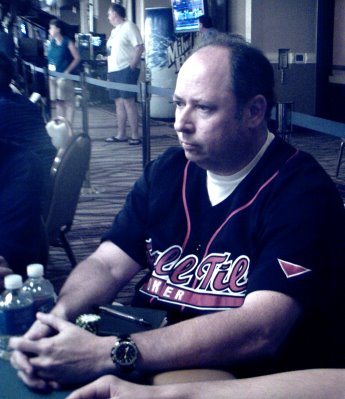 (Michael Craig watches his table's action in the 2006 WSOP Main Event.)
Furthermore, Michael's a genuinely nice man, who I had the chance to talk to repeatedly at the WSOP. Too nice a man to be a lawyer (his former profession). But some time back I left a comment somewhere deep in his blog that I realized only much later that he could take as a personal slap, even though the comment I made wasn't even meant to be about him --- it was, rather, about some third-party readers and writers at a different site. It had to do with the inane practice common to writers of all types (not just poker ones) of sucking up to (a) their friends, and (b) the biggest names in the field. For instance, over at the left you'll notice the link to Tau of Pauly, "Dr. Pauly" McGuire's long-running, very well-written blog. But do you need me to preach to the choir, and waste your time telling you how great a blog it is?
I think not. I'll point out the excellence when it's unusual or distinctive, and figure that all of us should expect the rest, the merely excellent, or pretty-good, or whatever it happens to be. Nonetheless, there are those sites whose owners believe that this form of writerly "group masturbation" (as I'm fond of calling it) is the way to go. It just sort of sickens me, and when I see it carried to extremes, it can put me on a little bit of tilt, too. It's dishonest writing, the same way that the movie reviewer at the Tribune Co. division I once worked for gave letter grades to all the movies he reviewed. Problem is, he never gave even the worst waste of celluloid a grade worse than "C". What a weenie.
That's cheating the reader, just the same way that waxing enthused about everything under the sun is, too. It makes the telling suspect.
It's okay to praise the good, but too often we're afraid to condemn the bad... or at least to point out what's wrong or improveable with the merely okay. Sometimes the preponderance of this secondary garbage can lead to tilt; in our own times, each of us is guilty not of saying things wrongly, but of saying things that one discovers only later have other, hidden meanings.
As with Vos, and the above. Et tu, tilt. And bon voyage, too.
Consider it the theme for this posting.
A week or so ago, I posted a funny bit excerpted from a 2+2 posting wherein young Aussie pro Mark Vos (pronounced "Foss") kinda sorta went on tilt after a string of beats to Mike Matusow, and let loose with one of the most succinct, all-encompassing insults ever to grace a chat window. If you haven't checked out that post, then go ahead; it's probably worth the visit.
 And here's the kicker, but recognized only from a distance: There was a far more questionable slip of the tongue from Vos in that heat of the moment exchange. (Image source: Wikipedia.com) I now excerpt this little snippet of text, from just after the line that generated that other post's heading:
Mark Vos: im just being honest
Mark Vos: lol
Mark Vos: im not sur
Mark Vos: but im sure mikey wins a red on red confrontation (italics mine)
Okay, wow. And I missed that the first time, as did everyone else. "Red on Red" is code for the Full Tilt "pros" and official "friends" on that site. Did Vos infer that he suspects that the pro-vs.-pro matchups on Full Tilt are rigged in favor of Matusow? It sure reads that way.
But I don't believe it, nor, I'm sure, does Vos; it was indeed just one of those things that slipped out in the tilt of the moment. Still, it makes you wonder just what some of these guys are thinking about when they do tilt, the willingness of even fledgling pros to grasp out at the irrational to explain away a run of bad luck or a nasty confluence of events.
It's certainly not some sort of indication that online poker is rigged; I believe that oft-muttered line of hooey about as much as I believe Matusow's post-drug arrest line that he was just doing a favor for a friend. Yah, and I'd kick both their asses at the table, if I only had the money.
But tilt is a funny thing; as I said above, we all do it. One frustration involving me involves none other than Michael Craig, the author of the Professor, the Banker, and the Suicide King. I'm in the minority on one thing concerning the book, because I think it's just an -okay- tale, nothing great. It's neat to have the story of that biggest-of-all-big-games captured into text, but I think the book has serious flaws, about what one would expect of a writer's first major effort. For what it's worth, I think that Michael's subsequent telling of the later matchup, serialized in Bluff, was much better, far more engaging writing, and he's written some nice pieces over at his new blog, too. As a writer, he's gotten much better.
 (Michael Craig watches his table's action in the 2006 WSOP Main Event.)
 Furthermore, Michael's a genuinely nice man, who I had the chance to talk to repeatedly at the WSOP. Too nice a man to be a lawyer (his former profession). But some time back I left a comment somewhere deep in his blog that I realized only much later that he could take as a personal slap, even though the comment I made wasn't even meant to be about him --- it was, rather, about some third-party readers and writers at a different site. It had to do with the inane practice common to writers of all types (not just poker ones) of sucking up to (a) their friends, and (b) the biggest names in the field. For instance, over at the left you'll notice the link to Tau of Pauly, "Dr. Pauly" McGuire's long-running, very well-written blog. But do you need me to preach to the choir, and waste your time telling you how great a blog it is?
I think not. I'll point out the excellence when it's unusual or distinctive, and figure that all of us should expect the rest, the merely excellent, or pretty-good, or whatever it happens to be. Nonetheless, there are those sites whose owners believe that this form of writerly "group masturbation" (as I'm fond of calling it) is the way to go. It just sort of sickens me, and when I see it carried to extremes, it can put me on a little bit of tilt, too. It's dishonest writing, the same way that the movie reviewer at the Tribune Co. division I once worked for gave letter grades to all the movies he reviewed. Problem is, he never gave even the worst waste of celluloid a grade worse than "C". What a weenie.
That's cheating the reader, just the same way that waxing enthused about everything under the sun is, too. It makes the telling suspect.
It's okay to praise the good, but too often we're afraid to condemn the bad... or at least to point out what's wrong or improveable with the merely okay. Sometimes the preponderance of this secondary garbage can lead to tilt; in our own times, each of us is guilty not of saying things wrongly, but of saying things that one discovers only later have other, hidden meanings.
As with Vos, and the above. Et tu, tilt. And bon voyage, too.
Sunday, September 03, 2006
Waiting for Richard Lee's Laundry List
Anyone keeping up with the Richard Lee saga has to be shaking their heads as ever more sordid and silly details keep emerging. One of the most inane, as reported here, is that Lee was brazen or reckless enough to write "gamb. loss" in the memo field of several checks he wrote on his own account.
 Now that'll get ya noticed. But whether or not Lee was actually running an internet bookmaking site --- the site traced to Lee carries official Internic registration info showing San Juan, Costa Rica offices --- there's another aspect that has more than a few people a bit uneasy: rumors are circulating that Lee's lists of betting customers include many well-known San Antonio figures, who would probably just not rather have their betting joneses made public.
Awww. I'm reminded of the time when I worked for a computer processing company behind the scenes of several large credit unions. On one occasion, our perpetually drunk lead programmer didn't properly test a field change he'd made to a program, resulting in a dozen or more statements for "secret accounts" being mailed to the homes (and wives) of the "leading husbands and citizens" who had squirrelled away some funny money. Now that was an "ooops" of major proportions.
But I've got a bit of an attitude about this type of thing --- I figure if the bookie or the madame or whoever it happens to be takes the fall for all the customers, and certain lists are out there, then the presence of big names shouldn't be squelched just because they've got the cash and connections to make those lists disappear. The worst type of justice, after all, is that which is purchased.
But whatever. It's been a long week with not much good poker news. Maybe next week, things will turn around, right?
 Now that'll get ya noticed. But whether or not Lee was actually running an internet bookmaking site --- the site traced to Lee carries official Internic registration info showing San Juan, Costa Rica offices --- there's another aspect that has more than a few people a bit uneasy: rumors are circulating that Lee's lists of betting customers include many well-known San Antonio figures, who would probably just not rather have their betting joneses made public.
Awww. I'm reminded of the time when I worked for a computer processing company behind the scenes of several large credit unions. On one occasion, our perpetually drunk lead programmer didn't properly test a field change he'd made to a program, resulting in a dozen or more statements for "secret accounts" being mailed to the homes (and wives) of the "leading husbands and citizens" who had squirrelled away some funny money. Now that was an "ooops" of major proportions.
But I've got a bit of an attitude about this type of thing --- I figure if the bookie or the madame or whoever it happens to be takes the fall for all the customers, and certain lists are out there, then the presence of big names shouldn't be squelched just because they've got the cash and connections to make those lists disappear. The worst type of justice, after all, is that which is purchased.
But whatever. It's been a long week with not much good poker news. Maybe next week, things will turn around, right?
Saturday, September 02, 2006
Sky TV Announces Screening Plans for "Million Dollar Cash Game" Series
Stop me if you've heard this one already --- it's about bringing a high-stakes, real-life cash game to TV.
As reported over at online-casinos.com:
"All In Sports, formerly known as The Poker Channel, will be bringing another game of high-stakes poker to television screens in the U.K. next year with the 'Million Dollar Cash Game.'"
Uhhh, yep. Succees does indeed bring imitation. Among the pros who are currently "expected to participate" (love that noncommittal loophole, there) on "Million Dollar Cash Game" are: Phil Ivey, Gus Hansen, Howard Lederer, Erik Seidel, Jennifer Harman, John Juanda, Mike Matusow, Erik Lindgren, Chris Ferguson, Marc Goodwin, and Tony Guoga. Mike the Mouth and Tony G at the same table? Okay, now that could be fun. But seriously, the derivative nature of this program is seen in this line: "... this is the first high-stakes cash game to be produced and televised in Europe, promising something new for poker fans."
Fans without digital or satellite access, perhaps, depending on how well the owners of "High Stakes Poker" are doing with syndicating their own episodes. But the only thing new under this particular sun is the fact that the sun itself is rising six or seven hours earlier, that being over Europe instead of the States.
Matter of fact, I'm thinking of pitching a series from Antarctica, called "High Stakes, Cold Cash." It'll be the first-ever high-stakes poker game from the land at the bottom of the world, with chip girls dressed like penguins and a stage set derived straight from the Ice Palace. Okay, I'm being silly. And despite how lame the initial pitch is, there's something more telling behind "Million Dollar Cash Game."
 A visit to the UK version of pokernews.com hints at a Full Tilt connection behind this one; you'll notice that the roster of stars listed above are largely the "pros" or "friends of" for that major online site. And indeed, Ivey and Harman were two of the players whose contractual obligations with Full Tilt forced them to back away from the original high-stakes concept pushed by Mansion Poker, the Mansion Superstar Challenge. It's quite likely that this new program is plugging a perceived market hole, whether as a paean to the Full Tilt marquee players or not. Time will tell; right now "Million Dollar Cash Game" doesn't even seem to have its own web site. (Image source: fulltiltpoker.com)
As reported over at online-casinos.com:
"All In Sports, formerly known as The Poker Channel, will be bringing another game of high-stakes poker to television screens in the U.K. next year with the 'Million Dollar Cash Game.'"
Uhhh, yep. Succees does indeed bring imitation. Among the pros who are currently "expected to participate" (love that noncommittal loophole, there) on "Million Dollar Cash Game" are: Phil Ivey, Gus Hansen, Howard Lederer, Erik Seidel, Jennifer Harman, John Juanda, Mike Matusow, Erik Lindgren, Chris Ferguson, Marc Goodwin, and Tony Guoga. Mike the Mouth and Tony G at the same table? Okay, now that could be fun. But seriously, the derivative nature of this program is seen in this line: "... this is the first high-stakes cash game to be produced and televised in Europe, promising something new for poker fans."
Fans without digital or satellite access, perhaps, depending on how well the owners of "High Stakes Poker" are doing with syndicating their own episodes. But the only thing new under this particular sun is the fact that the sun itself is rising six or seven hours earlier, that being over Europe instead of the States.
Matter of fact, I'm thinking of pitching a series from Antarctica, called "High Stakes, Cold Cash." It'll be the first-ever high-stakes poker game from the land at the bottom of the world, with chip girls dressed like penguins and a stage set derived straight from the Ice Palace. Okay, I'm being silly. And despite how lame the initial pitch is, there's something more telling behind "Million Dollar Cash Game."
 A visit to the UK version of pokernews.com hints at a Full Tilt connection behind this one; you'll notice that the roster of stars listed above are largely the "pros" or "friends of" for that major online site. And indeed, Ivey and Harman were two of the players whose contractual obligations with Full Tilt forced them to back away from the original high-stakes concept pushed by Mansion Poker, the Mansion Superstar Challenge. It's quite likely that this new program is plugging a perceived market hole, whether as a paean to the Full Tilt marquee players or not. Time will tell; right now "Million Dollar Cash Game" doesn't even seem to have its own web site. (Image source: fulltiltpoker.com)
Online Site Pokertropolis Ceases Operations
From the "things inevitable" category comes a news release, courtesy of the good folks over at Pokernews.com, that Pokertropolis has ceased operation as of September 1st. Anyone with a current account balance at Pokertropolis is encouraged to check their account before September 7th, the last day that funds not already returned to remaining customers through some of the site's automated processes must be claimed.
 Pokertropolis customers who have ever used their own Neteller of Firepay account have been advised at the page linked above that their funds will be automatically refunded; there is no need to do a manual withdrawal process at this time. However, credit-card depositors must submit a credit card authorization form immediately, and anyone wishing to receive a physical check must also request one manually in the few days remaining.
Now, have any of you ever played at Pokertropolis? I must confess that I never have, despite the public-service portion of this posting, the above. Truth be told, the reason I never played there is the same reason many others eschewed the site --- Pokertropolis has been tainted for years by the seeming presence of computerized bots, used by the site to fill out tables and increase the flow of play. Is it true? Pokertropolis denied the allegations, but one of the leading online-poker 'bonus' sites, bonuswhores.com, had this to say about the pokertropolis site:
Pokertropolis
Pokertropolis is blacklisted because they use poker bots (computerized players run by the house) at their tables. Their management denies this, but anyone who plays there will realize that they are not playing against human opponents.
For what it's worth, the bots do not appear to have any unfair advantage over the players. However, the fact that they are used and then lied about is cause for rather large concern about Pokertropolis.
Note the "their management denies this" (referring to Pokertropolis management), but nonetheless, the connection and the taint were long-standing in the poker arena. I can't offer first-person anecdotes on the matter, but I can offer that one of the reasons I never gave the site a whirl was because of the comments like these, found at bonuswhores.com and other places. Even online poker has its short list of taboo topics, and "bots" is one of the leading entries on that list.
As such, and unable to overcome the long-lasting stigma, it's no wonder that Pokertropolis has now ceased to be. So long, site; bots or not, I never knew ye.
 Pokertropolis customers who have ever used their own Neteller of Firepay account have been advised at the page linked above that their funds will be automatically refunded; there is no need to do a manual withdrawal process at this time. However, credit-card depositors must submit a credit card authorization form immediately, and anyone wishing to receive a physical check must also request one manually in the few days remaining.
Now, have any of you ever played at Pokertropolis? I must confess that I never have, despite the public-service portion of this posting, the above. Truth be told, the reason I never played there is the same reason many others eschewed the site --- Pokertropolis has been tainted for years by the seeming presence of computerized bots, used by the site to fill out tables and increase the flow of play. Is it true? Pokertropolis denied the allegations, but one of the leading online-poker 'bonus' sites, bonuswhores.com, had this to say about the pokertropolis site:
Pokertropolis
Pokertropolis is blacklisted because they use poker bots (computerized players run by the house) at their tables. Their management denies this, but anyone who plays there will realize that they are not playing against human opponents.
For what it's worth, the bots do not appear to have any unfair advantage over the players. However, the fact that they are used and then lied about is cause for rather large concern about Pokertropolis.
Note the "their management denies this" (referring to Pokertropolis management), but nonetheless, the connection and the taint were long-standing in the poker arena. I can't offer first-person anecdotes on the matter, but I can offer that one of the reasons I never gave the site a whirl was because of the comments like these, found at bonuswhores.com and other places. Even online poker has its short list of taboo topics, and "bots" is one of the leading entries on that list.
As such, and unable to overcome the long-lasting stigma, it's no wonder that Pokertropolis has now ceased to be. So long, site; bots or not, I never knew ye.
Subscribe to:
Posts (Atom)